Author Archives: combs2jc

combs2jc's avatar

About combs2jc

I am a dad first. I am also a writer, artist, submarine vet and adventurous. Most of my writing is non-fiction. I concentrate on memior and history. I also have an annual Christmas book I put out that is free, "Christmas Patrol". "Christmas Patrol" gives vetrans (multiple countries and services) a chance to encourage those men and women currently serving their country during the holidays. My readers have been asking for a website and here it is. Feel free to write, I read everything. Thank You!

Back To Titanic


In the last two years I have made three new posts on Titanic.

One was sharing a paper Titanic model made by the husband of a fellow writer. The second was some new Titanic news (yes I know, a little unbelievable but it was). And the third was an article on newlyweds on the Titanic. I made the decision a long time ago to stop writing about Titanic, there are too many projects in my in-box (including articles on other ships). But my staff and some of the readers have been asking me for another Titanic and Olympic article.

So, on 13 April 2014, we will publish another article in the “Titanic and Olympic: How to tell them apart in photographs” series.

Comments Off on Back To Titanic

Filed under history, New, Olympic, ships, Titanic

The Signorelli Family


I just got back from my daily walk-about. Walk-about, I love that phrase, I borrow it from my Australian friends. Though their walk-abouts are longer than mine, I’ll still trek around for a few hours. I have always believed that if you want to see America, real America, meet its people and find out about it you have to spend shoe leather. I have met some great people while on my feet. People like a police dog on his first day on the job in Ohio, and a guy and his dog walking across America (both of them with their own backpack), then there is John at the Napa store in Guadalupe, California. John may run the Napa store, but John really is a historian. Not the kind in a university, no John is my kind of historian. He is the kind of historian who knows his neighbors and welcomes strangers. John is one of those rare men who know all about his town and its people. Not the gossiping kind, no John is an historian of the best kind, and he doesn’t mind telling you the history of his little town, if you have a few minutes.

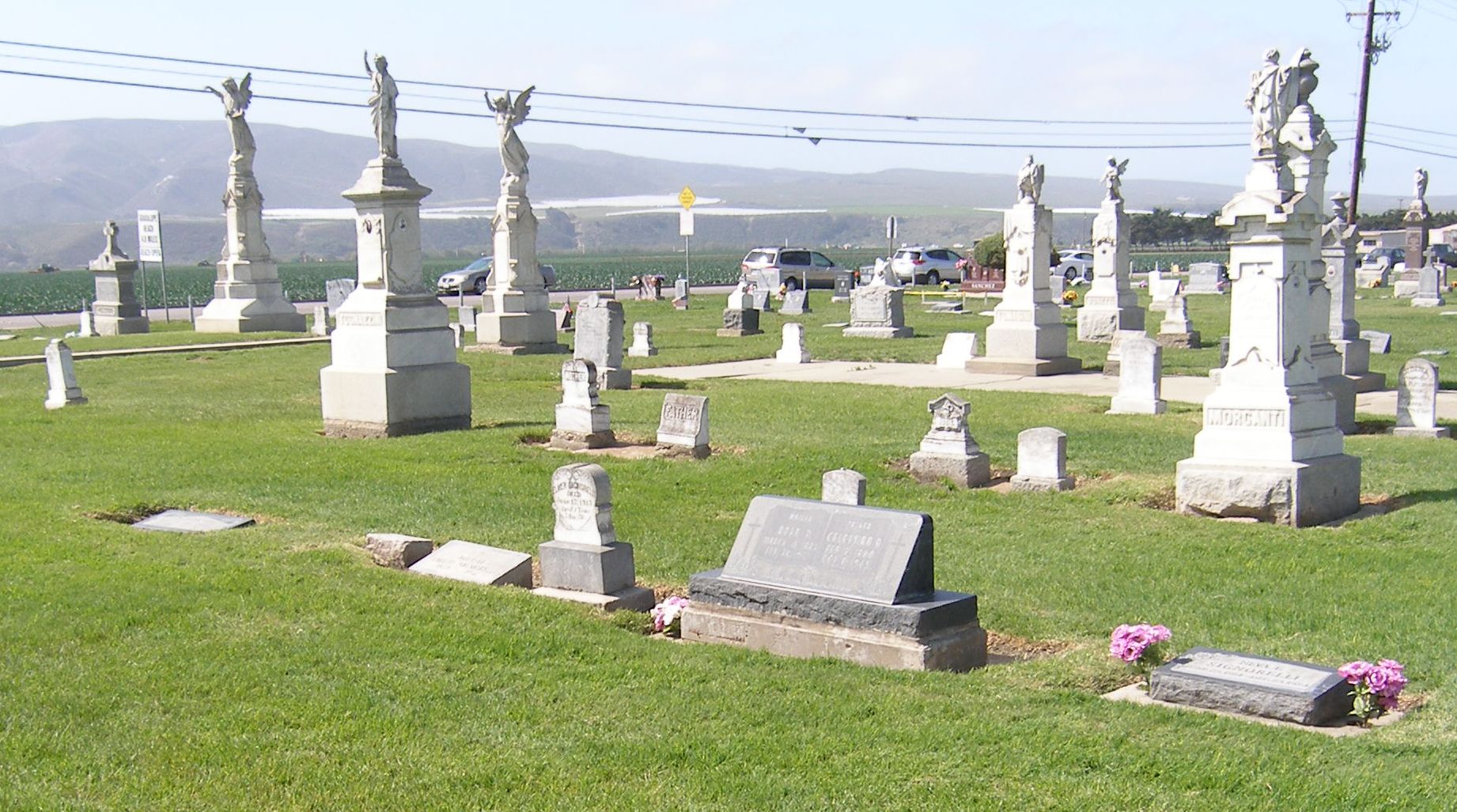
Today I visited the Signorelli family. I didn’t stay with them long and no words passed between us. But, I spent quite a bit of time thinking about them as I went on the rest of my walk-about. I mean what do I know about them, really. Well there is Rosa and Celestino, Celestino’s older brother Emilio (he never married), and younger sister Neva. Then Alfred, he is the youngest of the four, oh and Alfred’s wife Mary.

I could see they endured pain. But, there was love too, the love of a large family, and the love of family still remembered. I had to know. Who were the Signorelli’s. I got home from my walk-about and set about trying to find out about the Signorelli’s.

Celestino was the second of seven children. He was born in Italy. His father moved the family to Switzerland when Celestino was seven-years-old. Then his father went to work in the coalmines of Africa where he died. By the time Celstino was twenty-years-old he already had two brothers and a sister living in California, and so he set out for America. He left Le Havre, France on October 14th, he sailed on the Savoy and reached New York city on October 26, making arrangements for the rest of his family to follow him the following January.

Celestino became a rancher and farmer, then he went into business with his brother-in-law. After that, Celstino went into the hotel business which he did for a year and a half before he went back to ranching (milk cows). Rosa and Celestino had five children but lost two of them. Celestino started out very poor, but through hard work he made a good life for himself and his family.

Alfred married a local girl, Mary Belloni. And, just as his brother before him became a successful farmer. As I read about the Signorelli family I saw a family who started out in poverty, leaving their native Italy for Switzerland, but still unable to shake the bonds of poverty. They left Switzerland they came to America and settled in central California. Through hard work, they provided a good life for their family and became active and important members of a new, but growing community. I like the Signorelli family, I like them a lot.

I have a lot in common with the Signorelli family; you have a lot in common with the Signorelli family. You see our triumphs and tragedies are not new. One hundred years ago, Alfred and Celestino went through the same trials and had the same celebrations you and I do. They made it, and they did such a good job at creating a family of love and hope, that even to this day, fifty years after their deaths, you can still find flowers on the graves.

Yup, I like the Signorelli family. I think I have to ask John about them tomorrow.
Signorelli family in the first row

Signorelli family in the first row

Comments Off on The Signorelli Family

Filed under New

” … For Today.”


I remember some kids on the playground making fun of a classmate because he was adopted. They did not let up until he was crying. The next day this kid came back to school, and again the bullies started to make fun of him because he was adopted.

But, this time he turned to the bullies and said, “My parents could have any kid they wanted and they picked me. Your parents are stuck with you.”

In many ways, America is like that child. Immigrants to America could have stayed in their native land or they could have chosen to go to any other country. But, they chose America. They chose America because of Americans before us who believed in a land of equal opportunity, a land of equal protection under the law, a land of freedom. Americans before us believed in these principles, lived, by these principles, and taught these principles to their children. They defended these principles with their words, with their actions, and with their blood.

The immigrants who come here to be American have sacrificed just as much on their long and arduous journey to our shores. They are American. In addition to the trade deficit, America has an immigrant deficit too.

That immigrant deficit exists because of men and women like those who mentored me. They taught me the American dream, their version. In their version each man and woman is free to live their life to the fullest extent they are able. To build a life which enables them to follow the “pursuit of happiness” as outlined in the American Declaration of Independence. A pursuit that enables them to have a better life than their parents, and their children to have a better life than they have. In their version, we are also our brother’s keeper. However, as Jesus pointed out to his disciples there will always be the poor. Though, this fact does not free us from our responsibility. But, it is not possible for one person to help everyone throughout the world who is in need of help. So, what do we do?

You help those who cross your path. You help those who are ready to reach out, stand on their own, and pursue their own happiness. The ones who just need a little help to stand, they are ready to do the reaching on their own. No, you cannot help everyone. But, every day you can help someone. And today, that one someone is enough – for today.

Some people will say derisively, “That is not the American dream. Americans are not the only ones who want that. Everyone wants that.” No, everyone does not want that. If every person in every nation wanted that, then American would not have an immigrant deficit. There are many in the world that do not have a live and let live attitude. They do not believe they are their brother’s keeper, they believe they are their brother’s master. They believe in death to those who believe different than they do. Children are not born to hate, they are taught hate by people who live by a different dream, a dream of mastery instead of a dream of brotherhood. That is their dream, a dream they teach to their children. So, what do you do?

You help those who cross your path. You help those who are ready to reach out, stand on their own, and pursue their own happiness. The ones who just need a little help to stand, they are ready to do the reaching on their own. No, you cannot help everyone. But, every day you can help someone. And today, that one someone is enough – for today.

Comments Off on ” … For Today.”

Filed under New

Pompeii


Pompeii was destroyed on 24 August 79 AD. The last several years before Pompeii’s destruction were volatile in the Roman Empire. Just two months and one day before Pompeii was destroyed, Emperor Vespasian died. Six years before, the First Jewish War ended with the fall of Masada after a siege of several months. In 69 AD, Emperor Nero committed suicide plunging Rome into a yearlong civil war, which the Romans called “The Year of Four Emperors.” Most telling was an earlier eruption of Vesuvius in 63 AD, which caused extensive damage in Pompeii and nearby Herculaneum.

Pompeii was a city of 20,000, including the suburbs outside the city walls. A small city, right? But the world population is 35 times larger today. That is the relative equivalent of a city of 700,000 today. If Pompeii were a modern city in the United States with the same relative population, it would be a city of 700,000, and the 19th largest city in the United States. Pompeii would be larger than El Paso, Boston, Seattle, Denver, Baltimore, Portland, Atlanta, Cleveland and many more cities in the United States.

Pompeii was actually a large seaport city the Roman Empire. Pompeii was also a resort city where many wealthy Romans had second homes, even Nero had a villa in Pompeii (his wife was from Pompeii). Rome is about 150 miles from Pompeii. Goods were shipped all over the Roman Empire from Pompeii, and Rome had a major naval base in Misenum on the other side of the Bay of Naples, across from Pompeii. Pliny the Elder was a senior Roman official, the commander of the naval fleet in Misenum and had his own villa nearby.

Pompeii had many of the amenities of a medium to large size city; market places (grocery and retail stores) laundries (dry cleaners), amphitheaters (sports and entertainment), public baths (spa’s), palestra’s (gym), livery (transportation), restaurants, bars, bakeries, family owned and run businesses, hotels, and of course there was the forum (mall) as well as brothels (over 40 in Pompeii), and many more businesses we would recognize today. They also had many of the same problems of our modern cities including crime and graffiti.

On the morning of 24 August, Pliny the Elder saw a mushroom cloud rise over the mountains and decided to investigate. But before he could leave his villa he received a message asking for help in evacuating the danger zone. He immediately ordered the fleet to help in a rescue attempt and left with his ships. The eruption had been preceded by earthquakes, but thay had been so numerous no one gave them much thought. The volcano put so much debris into the sky that it blocked all sunlight. That night a pyroclastic cloud descended Vesuvius with such speed and heat that the people of Herculaneum died instantly, the flesh melting from their bodies. Pompeii was a few more miles away and by the time the pyroclastic cloud reached the city, the temperature had gone down enough that the people survived, this time.

The next day the people of Pompeii were not so lucky. The fourth pyroclastic cloud to descend the mountain was hot enough to kill the people instantly, but it left their bodies and even their clothes intact. Altogether six pyroclastic clouds rolled down Vesuvius. Today the volcano is still active. If the next eruption is strong enough it could even threaten Naples.

4 Comments

Filed under New

International Women’s Day


This goes out to all my women friends around the world, and to my very special daughter (though she is not a woman yet).


International Women's Day

1 Comment

by | March 8, 2014 · 12:23 pm