Author Archives: combs2jc

combs2jc's avatar

About combs2jc

I am a dad first. I am also a writer, artist, submarine vet and adventurous. Most of my writing is non-fiction. I concentrate on memior and history. I also have an annual Christmas book I put out that is free, "Christmas Patrol". "Christmas Patrol" gives vetrans (multiple countries and services) a chance to encourage those men and women currently serving their country during the holidays. My readers have been asking for a website and here it is. Feel free to write, I read everything. Thank You!

Father’s Day in May


IMG_20140503_105103

As many of your already know April is a very hard month for me. But, May? Ah!

Today was the first Kentucky Derby in decades I have not watched, and I didn’t even notice. My baby, my little one, the babe I held in the palm of one hand (in what seemed like just last week) turned nine years old today. My daughter’s birthday is always the best father’s day of the year for me.

Which brings me to a question for all you dad’s out there.

Dad what do you do when your daughter gives you a pink friendship bracelet?

IMG_20140426_135640


IMG_20140426_135714

You wear it – of course.

Love you Pumpkin, Happy Birthday Sweetheart.

This one is for you, you will never know how happy you make me.

1 Comment

Filed under New

I Started Over Today … and You Can Too


None of us are perfect. Yeah, we’d like to be, but it is not going to happen. So, get over it.

521579_490175511044766_1174668531_n

We are not perfect, but we can have a good life. And you know what? It is a lot easier than you think …

579756_543868785633850_514202410_n

Just remember …

486488_268249209957949_706125051_n

Comments Off on I Started Over Today … and You Can Too

Filed under New

Titanic, 100 Years Worth of Breaking Up Theories.


First, we will look at the accepted version of Titanic’s sinking, and its evolution.

In 1912, it was believed the Titanic went down in one piece with the stern rising 90 degrees in the air, pausing, and then sinking beneath the waters; as most survivors claimed.

On 1 September 1985, the wreck of the Titanic was found by Dr. Robert Ballard. The wreck was found in two pieces the bow section almost 2,000 feet from the stern. The bow is relatively intact, but the stern looks like it was the victim of an explosion. This proved the ship did not sink intact, but broke up on the surface then sank.

The decks of the Titanic on the bow section at the break were collapsed down upon themselves. The explanation was, “Yeah, that must have happened when the Titanic hit the ocean floor. It hit with such force it collapsed those decks.” The reason for the stern section being in such bad shape? The experts could not explain it and did not know what happened to the stern.

From 1985 until 2008, this was the accepted theory, with slight modifications over the years.

Then in 2008, the book “Titanic’s Last Secrets,” came out. This book is about the research and Titanic exploration of the renowned wreck divers, shipwreck historians, and explorers Richie Kohler and John Chatterton (Deep Sea Detectives series on History Channel). They found two pieces of the double bottom of Titanic. They had the steel examined by experts. The conclusion? The steel would have been so brittle at the 30 degrees water temperature when Titanic sank that the keel would have only supported the stern rising to between 7 and 11 degrees before breaking. At this colder temperature the steel would not bend and stretch, it would fracture and break clean as if cut by a knife. So, now the new mainstream theory was the Titanic stern did not rise between 45 degrees and 90 degrees (as most survivors claimed), but only to about 11 degrees.

I didn’t buy it, I didn’t buy it in 1985. For one thing, if the force was so great to collapse thick heavy decks on the bow, what about those flimsy deckhouses? I looked at the ocean currents in the area at that time, and how long the stern remained on the surface after the bow disappeared. The two halves should have been a lot further than 2,000 feet apart if the accepted theory of the sinking were correct. I believed the ship broke on the surface, but not into separate halves. With the bow filled with water it would have been pulling on the stern, and the air-filled stern would have been more buoyant and resisted the bow. If the stern pivoted on the broken, but still attached section (like a hinge), it could indeed rise between 45 and 90 degrees into the air as the bow sank even deeper in the water. The stern needed something of weight beneath the water to allow it to rise straight into the air. Take an empty glass, turn it upside down and stand it on water in a water-filled sink. When you let go the glass falls over it cannot stand. The stern should not have been able to stand without the bow attached to it. There had to be a way of explaining what ALL of the witnesses saw and what the scientists discovered. I thought my 1985 theory was it.

I studied the published work of Kohler’s and Chatterton’s experts, and realized they did not take into account the temperature of the decks inside the Titanic, decks that were made from the same steel (though at a different thickness) as the keel and hull plates.

The wealthy women survivors testified to giving their coats and shawls to the handful of survivors from Titanic’s engineering department. These men were dressed in very thin clothing. The Titanic’s engine room was very hot, and the boiler rooms (where the steam was made) could reach temperatures over one hundred degrees. The decks in those areas would not be at freezing temperatures, they would not be brittle but, would stretch and bend instead of fracturing and breaking.

The night Titanic sank, the bow filled with water going lower and lower into the water raising the stern into the air. At an angle between 7 and 11 degrees, two sections of the Titanic’s double bottom broke free from the ship. The weight that had been borne by the keel was now transferred to Titanic’s interior decks and bulkheads (floors and walls), and they collapsed under the weight, pancaking down on each other above where the double bottom broke away. The stern settled back on an even keel and then began to rise into the air, as witnesses stated.


As more air escaped the stern, eventually the bow pulled the stern under. At a point, most likely less than 1,000 feet, the stern would have gone deep enough that the sea pressure would have exceeded the strength of the stern. At this point, the stern imploded separating the two halves of Titanic. The few remaining air pockets and the effects of the implosion would slow the stern down in its decent enough to land on the ocean floor 1,970 feet from the bow.

No evidence or witnesses discounted, the laws of science taken into account.

Comments Off on Titanic, 100 Years Worth of Breaking Up Theories.

Filed under history, ships, Titanic

Mermaids??? Yes, Mermaids! part two


I think I know who mermaids are, yes who, not what. But, to understand my theory about who mermaids are, it is helpful to understand how my mind works while doing research. When I research anything, I am not looking for something specific. I am looking for data, the evidence – all of it. Any theories I might have had are gone. I just want the data. Though it may be tempting to discount some of the evidence to make a theory stick, I know I am not going to find the truth that way. To be honest, I do research for me, just me. I still have the same curiosity I had as a kid and I need to know the five w’s and how.

Now back to our mermaids. Each piece of the evidence must be explained for a theory to be accurate. Looking at the range of dugongs and manatees, they do not live worldwide, yet mermaids have been sighted all over the world, so the scientists are wrong about that. Rereading some of the earlier accounts of mermaid sightings, I realized that not all mermaid sightings are of mermaids with a fish tail, some have legs like humans. As a matter of fact, part of the legend of mermaids is that they can go back and forth between legs and fish tail.

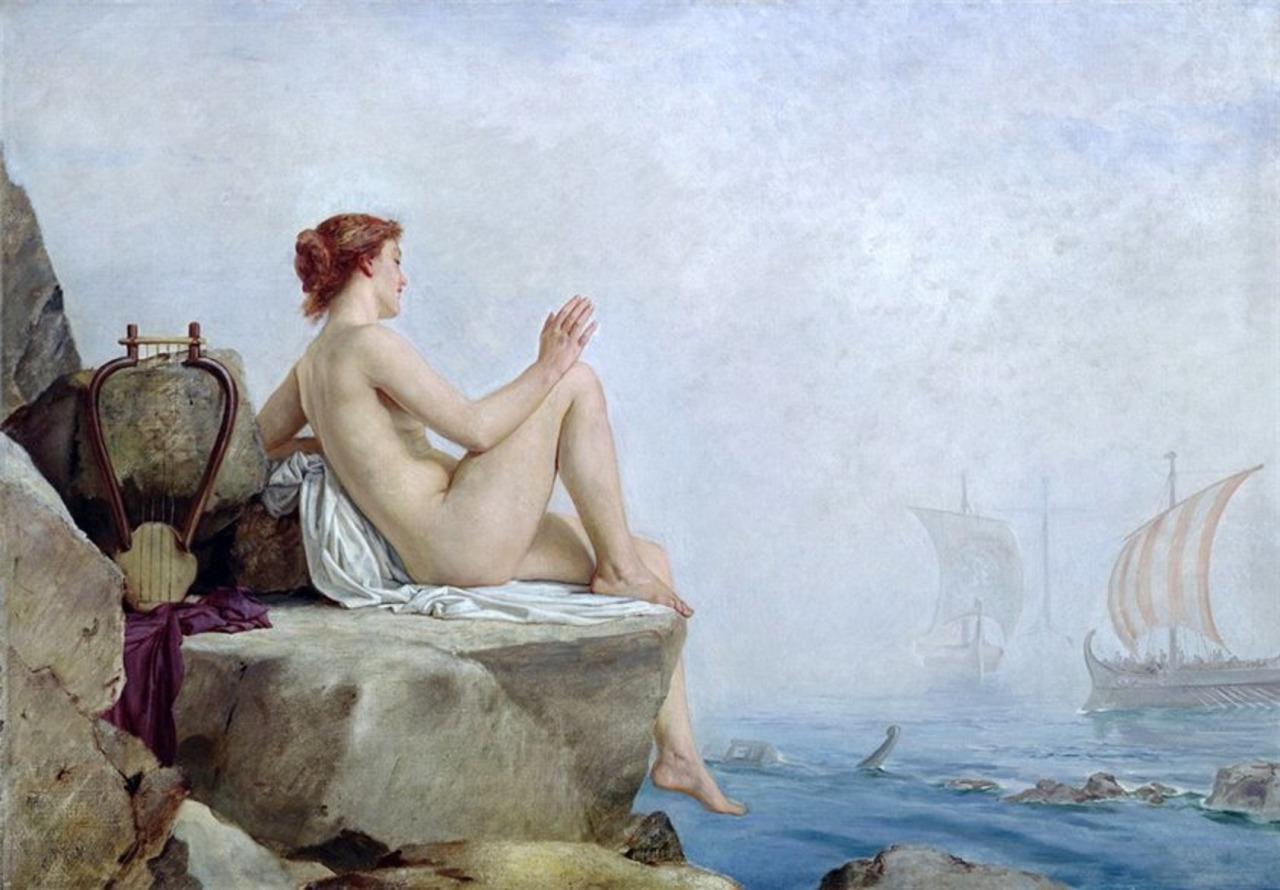
The Siren, oil on canvas, Leeds Art Gallery. source: http://www.wikipedia.org

Now I was not just looking for mermaids, I was looking for women. Women swimming, though not swimming for fun, some of the waters where mermaids had been sighted are very cold. No, these would be working women. I found that just such a thing has existed for thousands of years.

In centuries past women dove in deep waters holding their breath in search, primarily, of food to support their families. These women have also dove for sponges, pearls, and even to recover items from ship wrecks. Women were better at these dives because they have a higher body fat content than men, they can dive for longer periods of time. They would dive deep, rest on their return, and dive again, getting several dives in one day following this method. They dove wearing only loincloths. The cold wet clothing would make them even colder while they were resting, so they dove without clothing. Some of these divers would rub oil on their bodies to help keep warm. The water glistening on the oil on their bodies could possibly look like water glistening on a fish’s body.

Ama (pearl diver) in Japan. source: http://www.wikipedia.org

Did I find my mermaids? I now know where sightings of mermaids came from. In Korea and Japan, women still practice free diving just as women for centuries before them did. However, in our modern day, they wear thin suits for modesty. In Japan, they are called Ama and they dive for pearls. Did I find my mermaids in the waters of Japan, do mermaids exist? I borrow a paragraph from an esteemed colleague from the Sun.

Virginia Elizabeth, your little friends are wrong. They have been affected by the skepticism of a skeptical age. They do not believe except they see. They think that nothing can be which is not comprehensible by their little minds. All minds, Virginia Elizabeth, whether they be men’s or children’s, are little. In this great universe of ours, man is a mere insect, an ant, in his intellect as compared with the boundless world about him, as measured by the intelligence capable of grasping the whole of truth and knowledge. …”

Yes Elizabeth! Mermaids do exist!

1 Comment

Filed under history, myth, New, Titanic

Mermaids??? Yes, Mermaids.


Mermaids? Mermaids? “Say it ain’t so Joe!” I know I hear you, but wait, just stay with me. It is true, I am very methodical, and grounded in logic, particularly when it comes to science and history (my belief in a Supreme Being not withstanding). I follow the data, collect the evidence, and analyze the results. I take an all-inclusive approach to what I find. I don’t like data that seems to not fit. My research into the wreckage on the ocean floor of the RMS Titanic is an example of this attitude at work. I know all the evidence does fit, and it tells a unique story. If there is something that does not seem to fit in the story, something we cannot support with science and an all-inclusive explanation, then we are telling the story wrong. One phrase I never use is, “Yeah, well that must have happened when … .” There are no “must have’s.” All the answers are in the evidence. But, mermaids? Mermaids? Yes mermaids.

No, not Disney’s Ariel, not that kind of mermaid. My daughter loves Ariel. Once when she was six, and talking about mermaids to me, she suddenly said, “I know mermaids are not real daddy, but I wish they were.” Then she went right back to talking about mermaids. But, I am not talking about fictional mermaids. I am talking about real, flesh, and blood mermaids. Not exactly the type of topic we usually discuss. I mean mermaids are just myth or legend – right? Sure, in Weeki Wachee Aquatic State Park in Florida, they have mermaids, but they are women in suits.

Mermaids Marcy, Cyndi, Stayce, Shannon, and Ashley posing underwater with a boat anchor photo credit http://www.floridastateparks.org/weekiwachee/

No suits, no cartoons, no fiction I am talking about real mermaids; living, breathing, swimming mermaids.

The oldest stories of mermaids come from Assyria, more than 3,000 years ago. In ancient Greece, they were called sirens. From around the world, in every culture, we have mermaid folklore. Stories passed down through history telling us of sightings and interaction between people and mermaids. Even Columbus on his voyage to the New World, wrote in his logs of sighting mermaids in the New World. Edward Teach, the famed and feared pirate Blackbeard, believed in mermaids and ordered his men to steer his ships clear of waters where he believed they lived. From Australia to Arabia, Africa to Russia, Asia to Scandinavia, North America to South America there are stories of mermaids; it is a worldwide phenomena. So, what do scientists have to say about mermaids?

The scientists tell us that mermaids are the myths of sailors. Scientist say the sailors have mistaken manatees or dugongs for mermaids. I grew up on the St. Johns River, swimming and fishing within its waters, one of the seasonal homes of the manatee. I learned as a small boy, if you are still and do not chase them, manatee will come right up to you. Manatees are a gentle and curious giant, but one that could never be mistaken for a woman as you can tell by the photographs.

Manatee at the Sea World Exhibit in Orlando Florida source http://www.wikipedia.org

A Dugong near Marsa Alam (Egypt). source http://www.wikipedia.org

P. T. Barnum exhibited what he called the Fiji mermaid. Later, the Fiji mermaid proved to be a fake made possible by taxidermy, half monkey and half fish. Barnum’s Fiji mermaid was lost when his museum burned down in the 1860’s. Dr. J. Griffin supposedly caught Barnum’s mermaid in 1842, and it went on display in Barnum’s museum in June 1842.

Though Barnum’s mermaid was lost in the 1860’s fire, there are “fake Fiji mermaid fakes” that can still be seen. Each one is supposedly the original Barnum Fiji mermaid. I saw one at the Ripley Museum in St. Augustine, Florida. Other Barnum mermaids are at other curiosity museums and sideshows around the world. The Indian Trading Post in Banff Alberta has the Banff merman, which was created by the same method.

Banff Merman on display at the Indian Trading Post in Banff, Alberta. source http://www.wikipedia.org

Other fakes include photographs that showed up on the internet after the 2004 tsunami. Supposedly, these mermaids washed up on the shore after the tsunami, these were made in the same manner as the Fiji mermaid fake. In August 2009, mermaids were supposedly sighted and filmed off the coast of Kiryat Yam, Israel. The city offered a million dollar reward to anyone proving the existence of mermaids, the city still has its million dollars. In 2012, work on a reservoir in Zimbabwe stopped when the workers claimed they were chased away by mermaids. The best was yet to come, and not once but twice.

The cable channel Animal Planet aired a special in May 2012, call “Mermaids: The Body Found.” It was a television docufiction. Written and filmed like a documentary it was pure fiction. They even had actors playing scientists with NOAA (National Oceanic and Atmospheric Administration, an agency of the United States government). The response was so great, that two months later NOAA was forced to release a statement saying that no evidence has ever been found of mermaids.

In May 2013, Animal Planet was back with a sequel, “Mermaids: The New Evidence.” Once again, NOAA was forced to release a statement denying the existence of mermaids, and this time including a statement pointing out that the person identified as a NOAA scientist is actually an actor and no scientist by that name had ever worked for NOAA.

So, here we are, no evidence (fossils or bodies) has ever been found to support the idea that mermaids do now or have ever existed. Every photograph and film of a mermaid has proved to be a fake, and even the “actual” mermaids who have been put on display have proved to be fakes. Scientists say the sincere reported sightings, are people mistaking manatees and dugongs for mermaids. If that were not enough, my six year old daughter (almost nine now) knows mermaids are not real. With all the writing projects in my “in box,” why have I taken two weeks of my time to investigate mermaids? Like I said, if all the evidence does not fit the conclusion, then we have the wrong conclusion.

Mermaids are not manatees or dugongs. What mermaids are is … oops, we are out of time. We will finish this next week.

Have a great week and see you next Sunday for the conclusion of our mermaid series.

1 Comment

Filed under New