Category Archives: Titanic

Dr. Robert Ballard: Geologist, Oceanographer, Archeologist, Scientist, Naval Officer, Discover, Explorer, & So Much More !


An incredible list of accomplishments for a man only 69 years of age (born June 30, 1942), and that’s not all.

Doctor Ballard has undergraduate degrees in chemistry and geology from the University of California and a graduate degree in geophysics from the University of Hawaii, he also received an Honorary Doctorate (Doctor of Science) from the University of Bath.

One achievement for which Dr. Ballard will always be known is the discovery of the R.M.S. Titanic; but, he also discovered the German battleship Bismarck, the USS Yorktown, John F. Kennedy’s PT-109 and numerous ancient shipwrecks. Ballard searched for, but did not find the USS Indianapolis.

RMS Titanic

RMS Titanic (Photo credit: paukrus)

Yorktown conducts aircraft operations in the P...

Yorktown conducts aircraft operations in the Pacific sometime before the battle. A fleet oiler is in the near background. (Photo credit: Wikipedia)

USS Indianapolis

USS Indianapolis (Photo credit: Wikipedia)

The USS Indianapolis delivered the first atomic bomb to Tinian, and was sunk by Japanese submarine I-58 on its return trip. With a crew of 1,196, only 317 men survived. Most of the crew survived the sinking (896) with only 300 men going down with the ship. It was four days before the US Navy knew the USS Indianapolis was missing, in that time 575 men died from exposure, dehydration and shark attack (four men died after being rescued).

Our understanding of the ancient civilizations around the Mediterranean has been expanded by his discoveries and archeological work on ancient shipwrecks in the Mediterranean.

Commander Ballard USN Reserve also explored the sunken submarines USS Thresher and USS Scorpion for the United States Navy. It was while examining the USS Thresher for the Navy that he discovered that, unlike shallow water wrecks, deep water wrecks have a debris field that fans out from the wreck. The ocean currents carry the lighter material which comes from the wreck, down stream from the initial location of the wreck. The heaviest material sinking closest to the actual wreck site. This was the discovery that, Dr. Ballard states, allowed him to find Titanic. When searching for the Titanic all other explorers looked for the ship. Dr. Ballard looked for the debris field, knowing he could follow the debris field to the ship.

USS Thresher (SSN-593)

USS Thresher (SSN-593) (Photo credit: Wikipedia)

It was Dr. Ballard that developed a new technology he called “telepresence”. This allows researchers, explorers, and scientists to explore deep under the oceans while safely aboard a ship on the surface.

One question that had always plagued oceanographers is why does sea water contain the minerals that it does. Enter Dr. Ballard. Ballard discovered that all the water of the oceans is cycled through the earth’s crust. The water goes through cracks in the earth’s crust striking hot rocks were it becomes super-heated and dissolves the minerals from the rocks. The super-heated water then shoots through vents back into the ocean, laden with minerals.

Probably his greatest discovery is the new life forms he discovered around the vents on the ocean floor (he called them “black-smokers”). Dr. Ballard discovered new forms of life totally independent of the suns energy These new forms of life live in an environment that would kill all other forms of life on the planet. This discovery has far reaching effects, not just for the discovery of life on earth, but in the universe.

Before this discovery scientists assumed the best chance to find life on other planets would be to look for earth-like planets, the same approximate distance to their sun, as the earth is to its sun. We now know that life can exist independent of a sun, existing on the energy from the planet itself.

To learn more about Dr. Robert Ballard, I highly recommend his memoir EXPLORATIONS.

ISBN 0-7868-6042-1

You can also check out the other books by Dr. Ballard:

Cover of "Discovery Of The Titanic (Explo...

Cover via Amazon

Discovery of the Titanic

The Discovery of the Titanic, Exploring the Greatest of All Lost Ships

Discovery of the Bismarck

Lost Subs: From the Hunley to to the Kursk, the Greatest Submarines Ever Lost and Found

and others

5 Comments

Filed under books, New, ships, Titanic, USS Scorpion

RMS Titanic, SS Bannockburn & Shoes


This Sunday will be my article on Dr. Robert Ballard. There is more to Dr. Ballard than the average person is aware of; his work has touched undersea volcanoes, Word War 2, continental plates, and outer space to name just four.

I am working on an article For Unsolved Mysteries‘ web site on the “Flying Dutchman of the Great Lakes”, the SS Bannockburn.

&

Also, I am working on an article concerning all those shoes beside the Titanic and what they really mean. There is more too it than you might suspect. So, until Sunday take care and have a great day!

V/R,

Joe

GALVESTON, Texas (March 1, 2007) - Dr. Robert ...

GALVESTON, Texas (March 1, 2007) - Dr. Robert D. Ballard, founder of Institute for Exploration (IFE), speaks at a press conference held in Galveston for the Flower Garden Banks project. Nuclear research submarine NR-1 and Military Sealift Command (MSC) submarine support vessel MV Carolyn Chouest are scheduled to conduct a visual and acoustic survey of the Flower Garden Banks in the Gulf of Mexico. U.S. Navy photo by Mass Communication Specialist 1st Class John Fields (RELEASED) (Photo credit: Wikipedia)

More detailed map showing volcanoes active in ...

More detailed map showing volcanoes active in the last 1 million years (Photo credit: Wikipedia)


R/V Robert Ballard - U.E.F. Science Vessel (1)

R/V Robert Ballard - U.E.F. Science Vessel (1) (Photo credit: Dunechaser)

1 Comment

Filed under New, ships, SS Bannockburn, Titanic

History Channel’s: “Titanic At 100: Mystery Solved”


A very good program, I only wished they showed more of the mapped out debris field. There were only two problems I saw with the program.

First: The investigators went into their research with preconceived ideas about how the accident happened and how Titanic sank. (If you have not already read my two articles “MY Research Methods” (here’s the link http://wp.me/P1MLkF-9C ) and “My Research Methods: part 2” (here’s the link http://wp.me/P1MLkF-bZ ))

When they tested the rivets they tested them with the stress applied along the length of the rivet, as if something were hitting the side of the hull plate. They did not test the shear strength of the rivets. This would be true of the rivets on the bottom of Titanic. But the rivets whose failure caused the most damage were on the side of the ship. Titanic ran over an underwater ice shelf on the iceberg. It did not run into the iceberg, but over the iceberg. The bottom plates were pushed up by this underwater shelf across the one inch thickness and they flexed upward. However, at the turn of the bilge (where the bottom becomes the side of the ship) the underwater ice shelf was pushing up across the six foot (two meter) width of the plates.

Try this to see what I mean. Take a playing card, say the ace of spades, lay it flat on a table. Now pick the card up a thumb on each end, and while holding the card parallel with the table bend the card upward. This is how the hull plates on the bottom of Titanic flexed when it ran over the ice shelf. Now turn the card on its side so you can see the ace of spades and have someone push up on the thin edge that faces the table. It does not want to flex. That is what happened to the hull plates on the side of Titanic as it ran over the ice shelf.

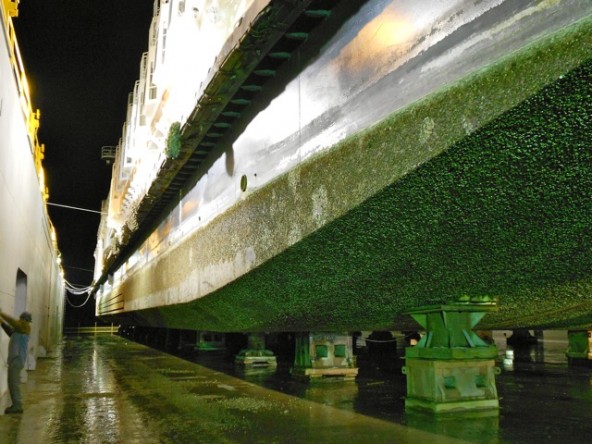
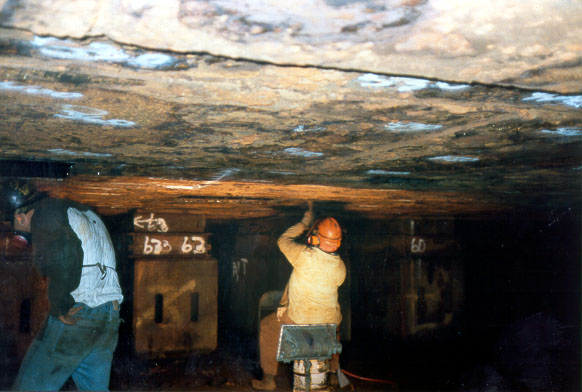
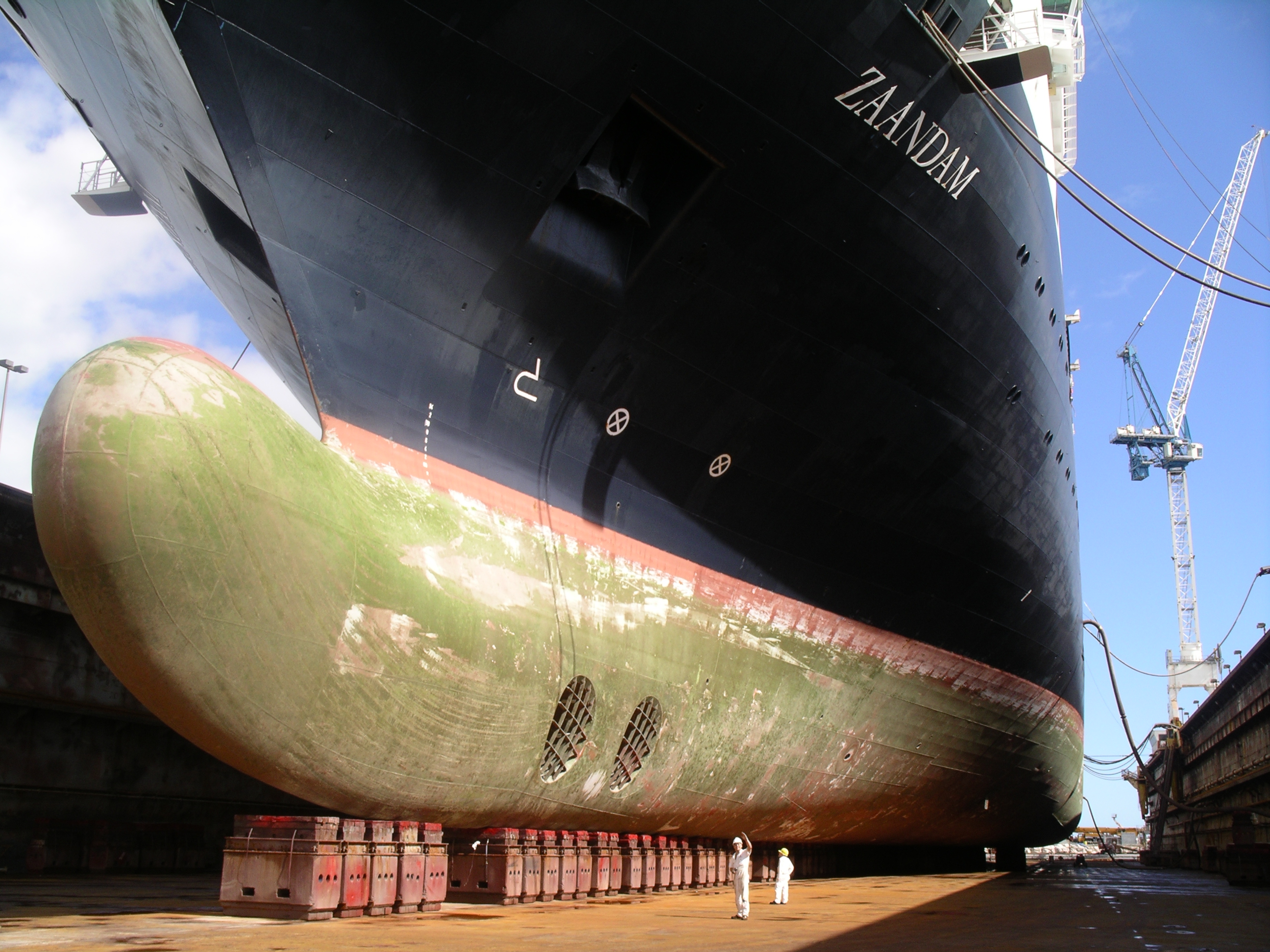
With the weight of the ship being pushed upward in a small area of the hull by the ice something had to give, and that was the rivets. Even when ships from any era are put in dry dock they must be supported every three to four feet (or less) or the hull will fracture, permanently damaging the hull. Look at the photos below.

American Queen a stern-wheel steam paddle steam ship.
Note blocks evenly spaced under hull to support the ship.
Photo courtesy Great American Steamboat Company.

WW2 battleship Texas in drydock. Notice the blocks every few feet to support the hull.
Photos courtesy Texas Parks & Wildlife

The modern Zaandam in drydock. Notice the blocks ever few feet to support the hull.
Photo courtesy of Wikimedia.

Second: They assumed that the ship broke into two separate pieces while it was on the surface. During the show they showed two things that conflict with eyewitness testimony. They showed the stern only rising a few degrees out of the water, and they showed something a lot less than 200 feet of the stern rising out of the water.

They noted the stretched steel on the broken pieces of double-bottom and correctly described this as happening when the bow was hanging on the stern. But those pieces stretched as the bow pulled the stern under.

Conclusion: I hate to point out these discrepancies. The show was outstanding as was the work of all those involved. However, unless we correctly identify exactly what happened and why, we are at risk of this happening again (as I stated in my book Titanic, A Search for Answers).

We will never get to the bottom of the Titanic disaster as long as we continue to look at the evidence searching for clues to prove our theories. We must look at the evidence AND THEN arrive at a theory.

2 Comments

Filed under New, ships, Titanic

The Elusive Lady : The Discovery and Exploration of RMS Titanic


The Elusive Lady : The Discovery and Exploration of RMS Titanic.

1 Comment

Filed under New, ships, Titanic

The Elusive Lady : The Discovery and Exploration of RMS Titanic


https://i0.wp.com/upload.wikimedia.org/wikipedia/commons/9/9c/Titanic_wreck_bow.jpg

Titanic Bow Courtesy Wikipedia

When the RMS Titanic sunk she took many secrets, as well as lives, with her. To this day there are many unanswered questions. But before her discovery there were conflicting views and theories, mainly had she sunk intact or broken in two? Where exactly had she sunk? Could the White Star liner be raised or had she been buried in a mudslide during the 1929 Grand Banks Earthquake? Today we know much more about Titanic than buffs did prior to Titanic’s discovery in 1985. This is mainly thanks to Ballard and his American-French expedition.

Dr. Robert Ballard’s desire to locate Titanic had been fueled by William ‘Bill’ Tantum, a longtime Titanic enthusiast. Although Tantum died a short time before Titanic’s discovery he had urged Ballard to find the great lady of the deep. So when the chance came, Ballard took it. The navy was agreeing to fund a three week test for Ballard’s newly developed Argo, an undersea video camera sled. Argo would dive from the ship and be towed along surveying the depths of the ocean. Ballard’s next step was to enlist the French. The French Research Institute for Exploration of the Sea (IFREMER) agreed to go along on the search for Titanic. For the first stage of the journey the French would search an area aboard their ship the Le Suroit, Ballard along with them. In the second stage four of the Frenchmen would join Ballard and his crew aboard the Wood’s Hole ship, the Knorr, where they would begin searching another area as well as testing Argo. Previous searches had proved fruitless and unrewarding, with millions of dollars going ‘down the drain’. The joint American-French explorers, however, hoped to do better.

The search began in July 1985 aboard the small vessel, the Le Suroit. The conditions were cramped as Ballard, three of his men and the French crew crowded onto the ship. The search turned up nothing and by August 12th Ballard and co-leader Jean-Louis Michel were aboard the Knorr.  The days dragged on, although not uneventfully. On August 28th, the Argo dived but on the ship it’s cable became damaged. In danger of snapping, the crew worked quickly and carefully to divert disaster. If the cable did snap it could easily kill or seriously injure those nearby. Fortunately, the cable was repaired.

By September 1st, things were not looking bright. Running out of time, it would seem Titanic had once again eluded her searchers. That early morning, Ballard had gone to his cabin as the watch changed. Things promised to be as monotonous as they had been for the past few weeks. At about 12:48 AM, Stu Harris noticed something on the screen that Argo was picking up. It appeared to be wreckage. But afraid it would be a false call and they would look foolish, no one went to get Ballard up. Instead now and then someone would say “Someone should get, Bob”, but no one volunteered. Then the unknowing cook wandered in and was told to get ‘Bob’. Ballard arrived soon after a boiler was spotted on the camera. When 2:20 AM, the time Titanic had sunk, came around the group huddled on the fantail of the Knorr and held a very short memorial service, raising the Harland and Wolff flag next to the Stars and Stripes. The location of Titanic revealed that Michel had indeed come close to discovering the wreck, as the Le Suroit had passed very near it. Had it not been for strong currents, France may have solely claimed the honor of the discovery

https://i0.wp.com/upload.wikimedia.org/wikipedia/commons/3/30/Captain_Smith%27s_bathroom.jpg

Captain Edward John Smith's Bathtub Courtesy Wikipedia

The next morning it seemed the entire world had learned of the discovery, as the Knorr found itself in the middle of a NATO exercise. But besides that when Ballard called to inform the Woods Hole Oceanographic Institution about the achievement, the institute already knew. The media would soon be harassing the poor explorers. The crew had never dreamed that the discovery would draw so much attention.

On September 2nd, the Titanic received her first human visitors since 1912. Investigation showed that Titanic had indeed broke apart. Her stern lay about half a mile to the south of the bow. Titanic had landed upright, but was not in pristine condition as some had believed. She was being ‘eaten’ by worms and was covered in ‘rusticles’. Still the wreck was haunting, to say the least. There was the bridge where orders had been issued to go hard-a-port, empty lifeboat davits, the first funnel was gone, as was the wheelhouse. And the debris field was an assortment of all kinds of odd and ends. Although plagued by bad weather, the expedition managed to compile an adequate collections of footage and images of the wreck. They hadn’t been able to explore the stern.

Finally it was time to head back for Woods Hole, where hungry journalists awaited. American and French relations were beginning to sour as Woods Hole and IFREMER argued over the ownership of the Titanic footage. Aboard the Knorr the Americans and French were beginning to feel the results of the rebuttals. The Knorr arrived at Woods Hole on September 9th, where Ballard and Michel gave a speech at the auditorium.

https://i0.wp.com/upload.wikimedia.org/wikipedia/commons/2/2f/ALVIN_Panorama.jpg

Alvin on the R/V Atlantis Courtesy Wikipedia

On July 12, 1986, Ballard returned to the site aboard the Atlantis II. He had twelve days to explore the wreck, but this time the French were not along. On this expedition Ballard planned to use the new ‘swimming eyeball’, Jason Junior (JJ) to explore the wreck. JJ would be able to explore areas that the submersible Alvin could not. This expedition was plagued with technical malfunctioning, nevertheless, it was successful. On the wreck Alvin‘s three man crew (Ballard included) found that although the wheelhouse was gone, the telemotor control was still present. The wood planking on the decks had been eaten away by sea creatures.

Via the massive hole above the Grand Staricase, JJ was able to maneuver into the ship’s dark interior. There they found a light fixture still in one piece. It was a marvelous find. The media had always asked such questions as were there any bodies. On the sixth dive Alvin was exploring the debris field and went by what Ballard had, to his horror, thought was a body It turned out to be a child’s doll, only the head remaining. Also laying about were shoes, some in pairs. The Alvin‘s crew came across a safe and tried to open it, but it had been rusted shut. Later they would find that the safe’s bottom had been rusted out. In any case no one was inclined to disturb a grave which was, and is, what Titanic had become.

https://i0.wp.com/upload.wikimedia.org/wikipedia/commons/b/b4/Robert_Ballard_at_TED_2008.jpg

Robert Ballard and the Bow Section Courtesy Wikipedia

On this expedition, Ballard was able to explore the stern section. It was in much worse condition then the bow part. Although the stern’s curved hull appeared to be in very good condition, much of the section had collapsed and was buried deep in the mud. When they left, the explorers placed a memorial plaque on the stern in memory of the Titanic’s dead and Bill Tantum. On their last dive, Ballard had a plaque placed on the bow, compliments of the Explorer’s Club of New York.

A further expedition made by James Cameron in 1995 showed that some wood did still exist. Cameron had ventured as far as the reception room on D deck where woodwork was still visible. Due to many human visitors since 1986, Titanic has deteriorated greatly, some expeditions even damaging the wreck. It is only matter of time until Titanic disappears completely from the ocean floor. Also many objects, including a piece of the hull, have been taken.

Source: The Discovery of the Titanic

3 Comments

Filed under Titanic