Monthly Archives: April 2012

Dr. Robert Ballard: Geologist, Oceanographer, Archeologist, Scientist, Naval Officer, Discover, Explorer, & So Much More !


An incredible list of accomplishments for a man only 69 years of age (born June 30, 1942), and that’s not all.

Doctor Ballard has undergraduate degrees in chemistry and geology from the University of California and a graduate degree in geophysics from the University of Hawaii, he also received an Honorary Doctorate (Doctor of Science) from the University of Bath.

One achievement for which Dr. Ballard will always be known is the discovery of the R.M.S. Titanic; but, he also discovered the German battleship Bismarck, the USS Yorktown, John F. Kennedy’s PT-109 and numerous ancient shipwrecks. Ballard searched for, but did not find the USS Indianapolis.

RMS Titanic

RMS Titanic (Photo credit: paukrus)

Yorktown conducts aircraft operations in the P...

Yorktown conducts aircraft operations in the Pacific sometime before the battle. A fleet oiler is in the near background. (Photo credit: Wikipedia)

USS Indianapolis

USS Indianapolis (Photo credit: Wikipedia)

The USS Indianapolis delivered the first atomic bomb to Tinian, and was sunk by Japanese submarine I-58 on its return trip. With a crew of 1,196, only 317 men survived. Most of the crew survived the sinking (896) with only 300 men going down with the ship. It was four days before the US Navy knew the USS Indianapolis was missing, in that time 575 men died from exposure, dehydration and shark attack (four men died after being rescued).

Our understanding of the ancient civilizations around the Mediterranean has been expanded by his discoveries and archeological work on ancient shipwrecks in the Mediterranean.

Commander Ballard USN Reserve also explored the sunken submarines USS Thresher and USS Scorpion for the United States Navy. It was while examining the USS Thresher for the Navy that he discovered that, unlike shallow water wrecks, deep water wrecks have a debris field that fans out from the wreck. The ocean currents carry the lighter material which comes from the wreck, down stream from the initial location of the wreck. The heaviest material sinking closest to the actual wreck site. This was the discovery that, Dr. Ballard states, allowed him to find Titanic. When searching for the Titanic all other explorers looked for the ship. Dr. Ballard looked for the debris field, knowing he could follow the debris field to the ship.

USS Thresher (SSN-593)

USS Thresher (SSN-593) (Photo credit: Wikipedia)

It was Dr. Ballard that developed a new technology he called “telepresence”. This allows researchers, explorers, and scientists to explore deep under the oceans while safely aboard a ship on the surface.

One question that had always plagued oceanographers is why does sea water contain the minerals that it does. Enter Dr. Ballard. Ballard discovered that all the water of the oceans is cycled through the earth’s crust. The water goes through cracks in the earth’s crust striking hot rocks were it becomes super-heated and dissolves the minerals from the rocks. The super-heated water then shoots through vents back into the ocean, laden with minerals.

Probably his greatest discovery is the new life forms he discovered around the vents on the ocean floor (he called them “black-smokers”). Dr. Ballard discovered new forms of life totally independent of the suns energy These new forms of life live in an environment that would kill all other forms of life on the planet. This discovery has far reaching effects, not just for the discovery of life on earth, but in the universe.

Before this discovery scientists assumed the best chance to find life on other planets would be to look for earth-like planets, the same approximate distance to their sun, as the earth is to its sun. We now know that life can exist independent of a sun, existing on the energy from the planet itself.

To learn more about Dr. Robert Ballard, I highly recommend his memoir EXPLORATIONS.

ISBN 0-7868-6042-1

You can also check out the other books by Dr. Ballard:

Cover of "Discovery Of The Titanic (Explo...

Cover via Amazon

Discovery of the Titanic

The Discovery of the Titanic, Exploring the Greatest of All Lost Ships

Discovery of the Bismarck

Lost Subs: From the Hunley to to the Kursk, the Greatest Submarines Ever Lost and Found

and others

5 Comments

Filed under books, New, ships, Titanic, USS Scorpion

Congratulations to Antonio Dias … Our Second Winner!


Every Saturday from April 14, 2012 until May 5, 2012 we will be announcing a winner of a free e-book or paperback(signed and inscribed).

Antonio will get to choose from one of the four following E-books: Titanic, A Search For Answers; One Last Thought; Alexandra; or One Last thought: Behind the Scenes. After he e-mails us (at admjcc2author@mail.com ) we will send him notification and a code so he can download him choice for free.

Would you like to win a free book?

Go to the right side of the page, below the Facebook feed and the archives section, to the section that says:

“Follow Blog Via Email”

Enter your e-mail address and click on the “follow” button. Then you will be entered in all 3 of our remaining contests … good luck. (we never release your e-mail address to anyone for any reason, we respect your privacy)

While you are waiting for your name to be drawn click on the links to read summaries of the available books to decide which book you want.

Titanic, A Search For Answers https://www.smashwords.com/profile/view/Combs2jc

Alexandra https://www.smashwords.com/books/view/62305

One Last Thought https://www.smashwords.com/books/view/55228

One Last Thought: Behind the Scenes https://www.smashwords.com/books/view/72025

Also, don’t forget that we have 7 books for free you can download any time you want at https://www.smashwords.com/profile/view/Combs2jc

Once again Congrats to Antonio !

You can checkout Antonio’s web site at http://antonio-dias.com/

2 Comments

Filed under books, New

RMS Titanic, SS Bannockburn & Shoes


This Sunday will be my article on Dr. Robert Ballard. There is more to Dr. Ballard than the average person is aware of; his work has touched undersea volcanoes, Word War 2, continental plates, and outer space to name just four.

I am working on an article For Unsolved Mysteries‘ web site on the “Flying Dutchman of the Great Lakes”, the SS Bannockburn.

&

Also, I am working on an article concerning all those shoes beside the Titanic and what they really mean. There is more too it than you might suspect. So, until Sunday take care and have a great day!

V/R,

Joe

GALVESTON, Texas (March 1, 2007) - Dr. Robert ...

GALVESTON, Texas (March 1, 2007) - Dr. Robert D. Ballard, founder of Institute for Exploration (IFE), speaks at a press conference held in Galveston for the Flower Garden Banks project. Nuclear research submarine NR-1 and Military Sealift Command (MSC) submarine support vessel MV Carolyn Chouest are scheduled to conduct a visual and acoustic survey of the Flower Garden Banks in the Gulf of Mexico. U.S. Navy photo by Mass Communication Specialist 1st Class John Fields (RELEASED) (Photo credit: Wikipedia)

More detailed map showing volcanoes active in ...

More detailed map showing volcanoes active in the last 1 million years (Photo credit: Wikipedia)


R/V Robert Ballard - U.E.F. Science Vessel (1)

R/V Robert Ballard - U.E.F. Science Vessel (1) (Photo credit: Dunechaser)

1 Comment

Filed under New, ships, SS Bannockburn, Titanic

U.S.S. Scorpion


U.S.S. Scorpion.

Panelists at the Marine Forensics Symposium outside Washington, call for a new expedition to the USS Scorpion’s wreck, saying it may put to rest the multitude of theories about the loss of the USS Scorpion. The expedition is to be led by famed Titanic explorer P.H. Nargeolet.

Comments Off on U.S.S. Scorpion

Filed under New, ships, USS Scorpion

History Channel’s: “Titanic At 100: Mystery Solved”


A very good program, I only wished they showed more of the mapped out debris field. There were only two problems I saw with the program.

First: The investigators went into their research with preconceived ideas about how the accident happened and how Titanic sank. (If you have not already read my two articles “MY Research Methods” (here’s the link http://wp.me/P1MLkF-9C ) and “My Research Methods: part 2” (here’s the link http://wp.me/P1MLkF-bZ ))

When they tested the rivets they tested them with the stress applied along the length of the rivet, as if something were hitting the side of the hull plate. They did not test the shear strength of the rivets. This would be true of the rivets on the bottom of Titanic. But the rivets whose failure caused the most damage were on the side of the ship. Titanic ran over an underwater ice shelf on the iceberg. It did not run into the iceberg, but over the iceberg. The bottom plates were pushed up by this underwater shelf across the one inch thickness and they flexed upward. However, at the turn of the bilge (where the bottom becomes the side of the ship) the underwater ice shelf was pushing up across the six foot (two meter) width of the plates.

Try this to see what I mean. Take a playing card, say the ace of spades, lay it flat on a table. Now pick the card up a thumb on each end, and while holding the card parallel with the table bend the card upward. This is how the hull plates on the bottom of Titanic flexed when it ran over the ice shelf. Now turn the card on its side so you can see the ace of spades and have someone push up on the thin edge that faces the table. It does not want to flex. That is what happened to the hull plates on the side of Titanic as it ran over the ice shelf.

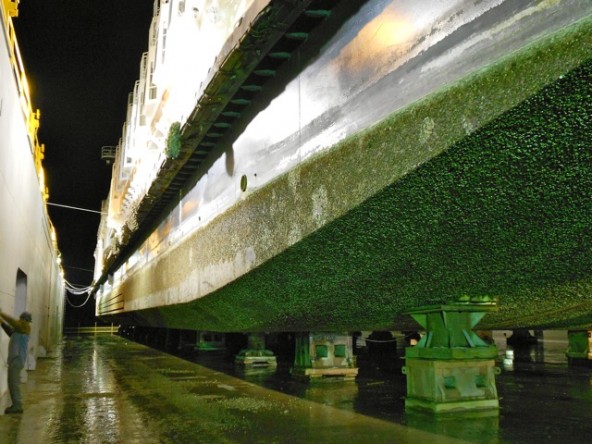
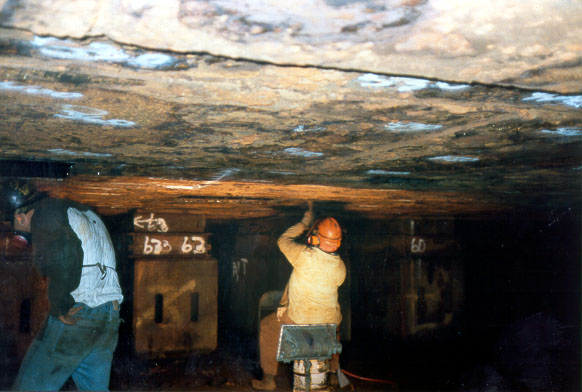
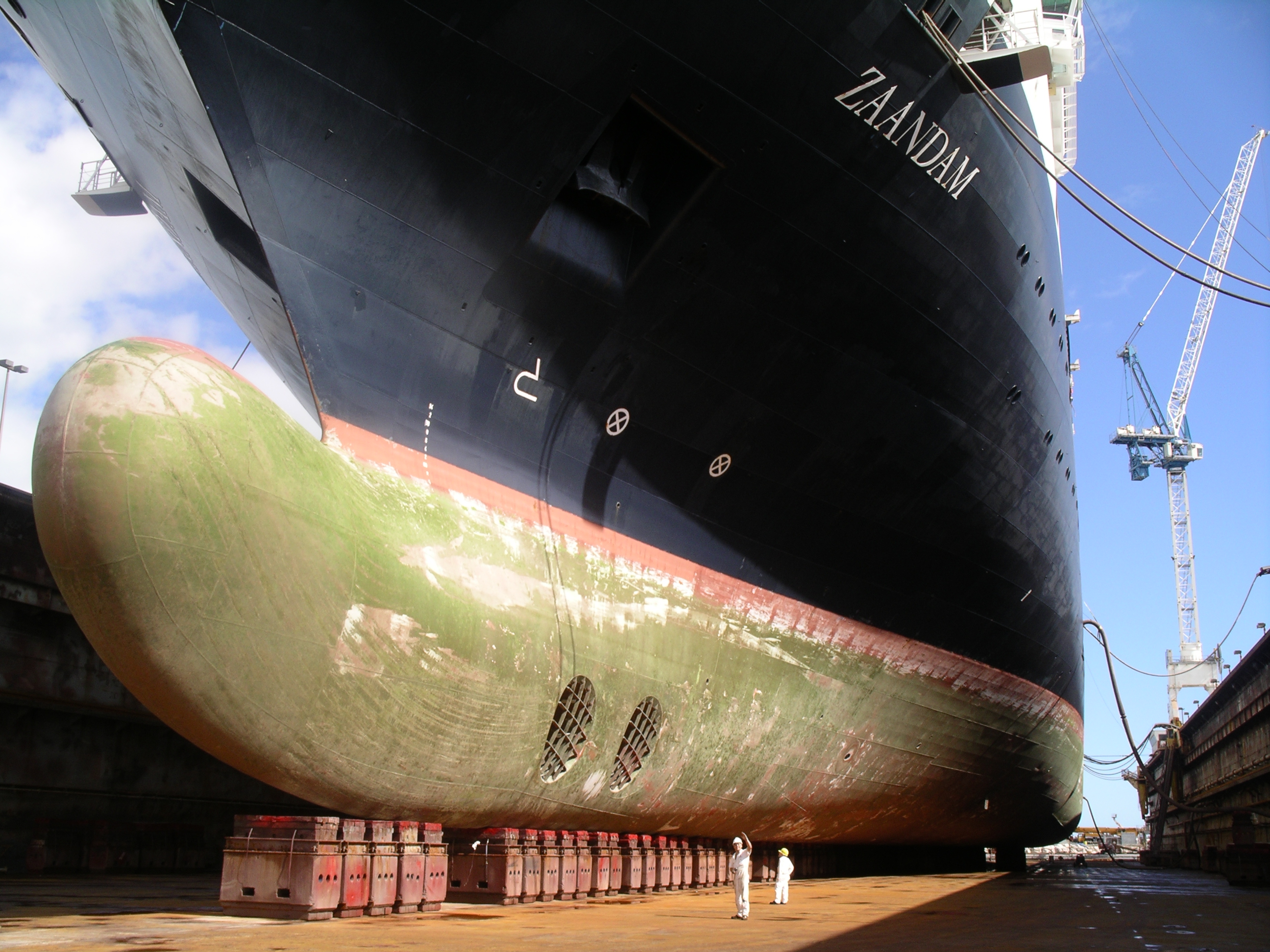
With the weight of the ship being pushed upward in a small area of the hull by the ice something had to give, and that was the rivets. Even when ships from any era are put in dry dock they must be supported every three to four feet (or less) or the hull will fracture, permanently damaging the hull. Look at the photos below.

American Queen a stern-wheel steam paddle steam ship.
Note blocks evenly spaced under hull to support the ship.
Photo courtesy Great American Steamboat Company.

WW2 battleship Texas in drydock. Notice the blocks every few feet to support the hull.
Photos courtesy Texas Parks & Wildlife

The modern Zaandam in drydock. Notice the blocks ever few feet to support the hull.
Photo courtesy of Wikimedia.

Second: They assumed that the ship broke into two separate pieces while it was on the surface. During the show they showed two things that conflict with eyewitness testimony. They showed the stern only rising a few degrees out of the water, and they showed something a lot less than 200 feet of the stern rising out of the water.

They noted the stretched steel on the broken pieces of double-bottom and correctly described this as happening when the bow was hanging on the stern. But those pieces stretched as the bow pulled the stern under.

Conclusion: I hate to point out these discrepancies. The show was outstanding as was the work of all those involved. However, unless we correctly identify exactly what happened and why, we are at risk of this happening again (as I stated in my book Titanic, A Search for Answers).

We will never get to the bottom of the Titanic disaster as long as we continue to look at the evidence searching for clues to prove our theories. We must look at the evidence AND THEN arrive at a theory.

2 Comments

Filed under New, ships, Titanic