
The first in a series of articles about the Hunley, and our search will start in an surprising place. See you Sunday.
Category Archives: ships
Sunday’s Article: The Hunley
Comments Off on Sunday’s Article: The Hunley
Filed under ships, submarines
Sunday’s Article: The Hunley

H. L. Hunley A Submarine Sinks a Warship (Photo credit: TradingCardsNPS)

English: apparently cropped from image found on http://www.history.navy.mil/photos/sh-us-cs/csa-sh/csash-hl/hunley.htm Photo #: NH 999 Confederate Submarine H.L. Hunley (1863-1864) Sepia wash drawing by R.G. Skerrett, 1902, after a painting then held by the Confederate Memorial Literary Society Museum, Richmond, Virginia. Courtesy of the Navy Art Collection, Washington, DC. U.S. Naval Historical Center Photograph. (Photo credit: Wikipedia)

CSS Hunley (Photo credit: AN HONORABLE GERMAN)
Well I have been promising we will go back to sea soon, and Sunday 5 August 2012 is the day. Sunday kicks off a series of articles on the Confederate submarine Hunley. I will give a short background into the Hunley and touch on three big controversies around the little submarine.
Related articles
- Bid for naval dominance: Russia significantly boosts nuclear fleet (uwtreasures.wordpress.com)
- Indonesia-Singapore Submarine Rescue Pact: Promoting Southeast Asian Naval Cooperation – Analysis (eurasiareview.com)
- Navy worker set fire to $400m submarine because he wanted to leave work early (investmentwatchblog.com)
- Ukrainian Builds Submarine He Saw in Dream (02varvara.wordpress.com)
- Arrest Made In Fire That Caused $400 Million In Damage To Submarine (wibw.com)
The Art Lesson
: Or how anyone can draw a sailing ship in 30 seconds or less
As I promised here is how John Alexander taught me (when I was not much older than Elizabeth) to draw a sailing ship. There are fifteen steps, and your first ship will take a little longer to draw than thirty seconds. But, after you draw a couple, you will probably be able to draw several ships in thirty seconds.
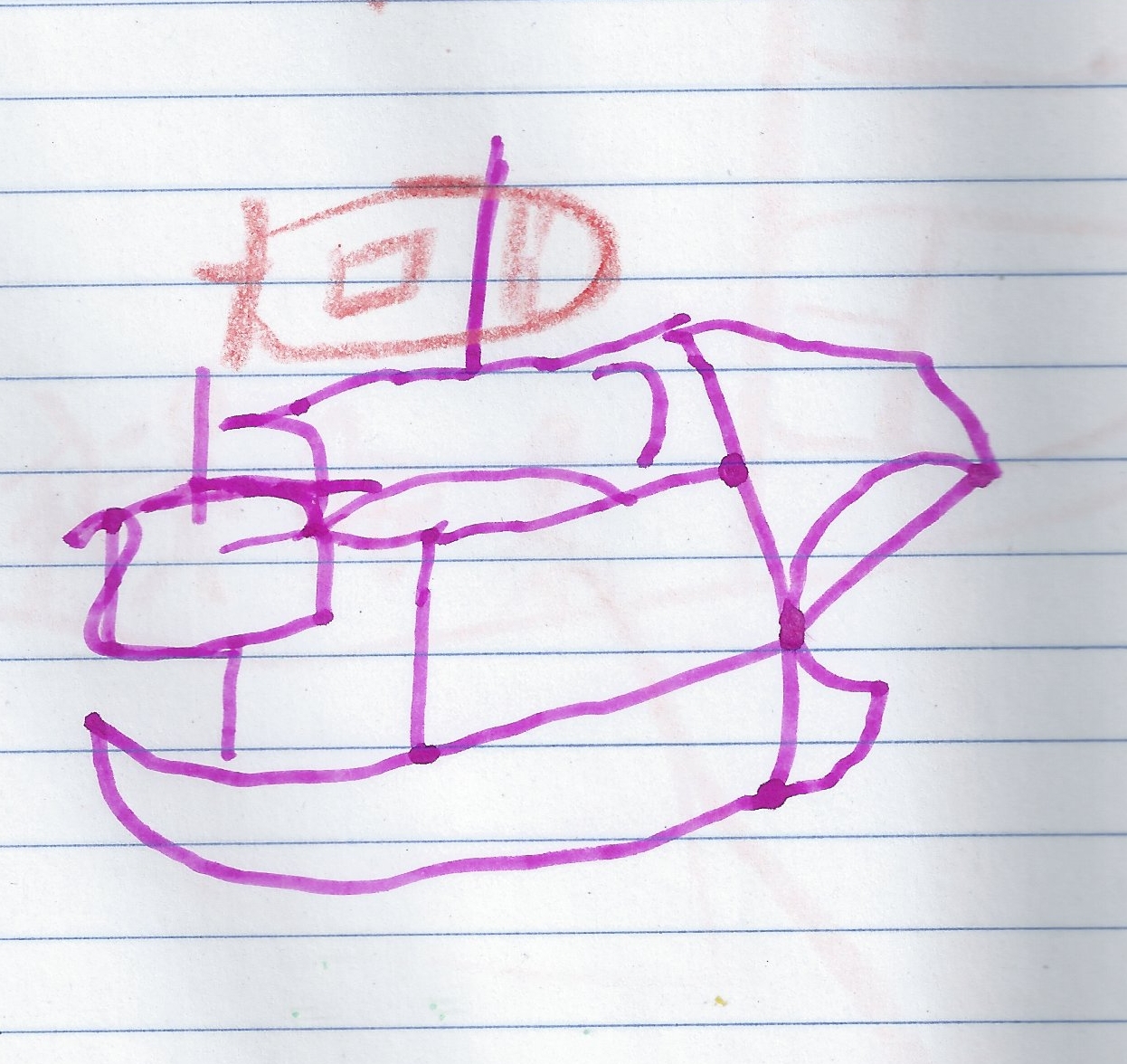
Elizabeth’s first sailing ship, drawn just like John Alexander taught me when I was not too much older than her. (Elizabeth added the flag on her own).
First, let’s see where we are going. Above is Elizabeth’s first drawing of a sailing ship. Your sailing ship will look similar to her’s.
Now that we know where we are going, we can start. Each step is numbered in the drawing, draw them in order and you will be fine.
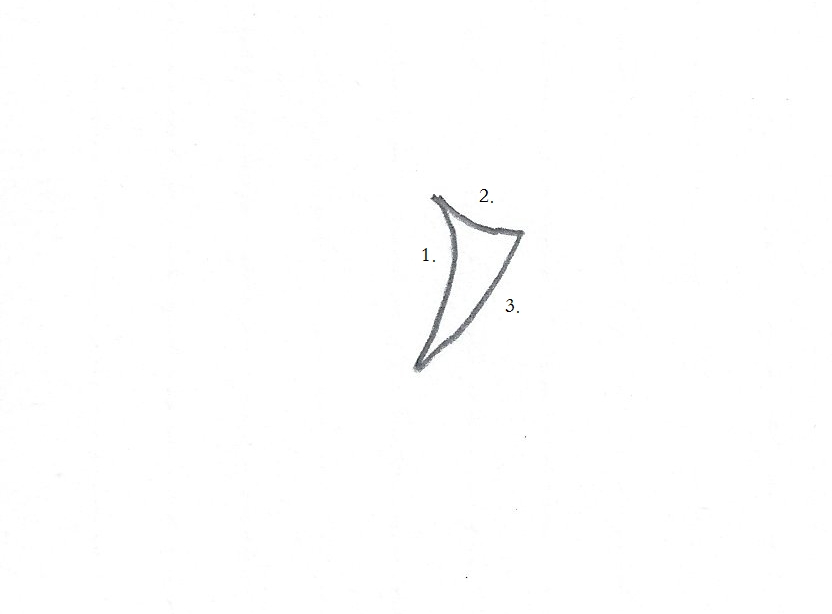
steps 1, 2, & 3
Step 1, we are going to draw the bow. The bow is the front of the ship and points in the direction the ship is going. Steps 2 & 3 are the left (port) side of the ship. In the drawing you can just see a little of the port side of the ship.
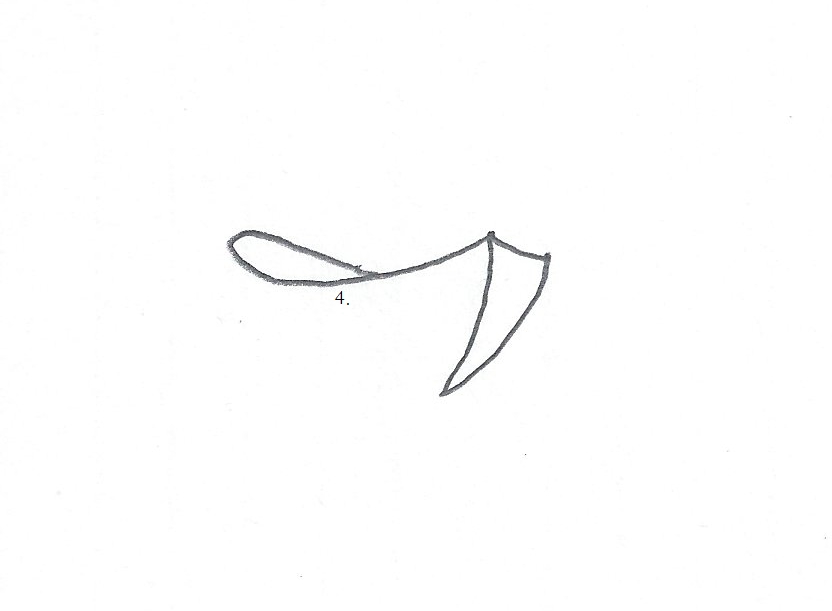
step 4
Step 4 looks complicated, but it is not. It may be easier for you turn your sheet of paper sideways and draw a flat letter “P”. The line is the top of the starboard (right) side of the ship. The inside of the loop is the deck at the stern (back) of the ship. You are giving your sailors a firm place to plant their feet.
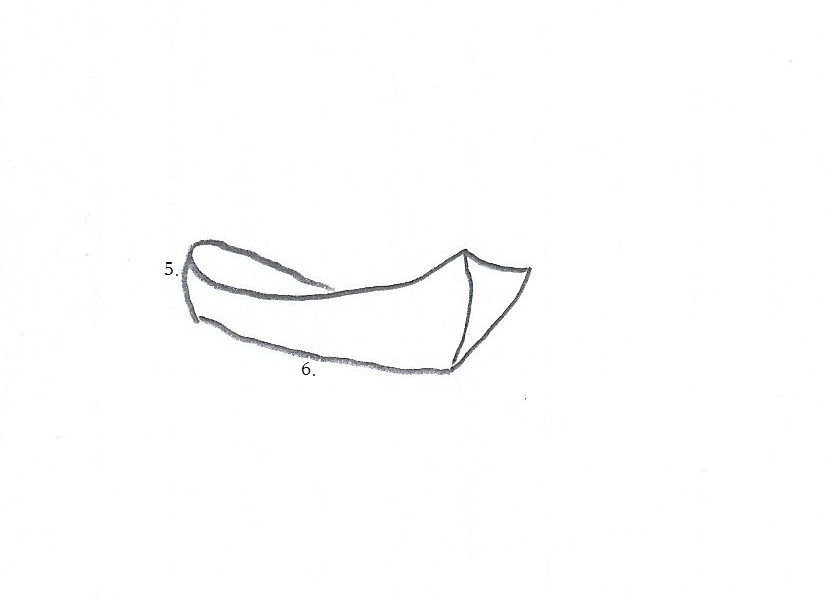
steps 5 & 6
Step 5 is the stern (back) of the ship and step 6 is the rest of the starboard (right) side of the ship. Your sailing ship is now starting to look like a ship. You have given your ship its form.
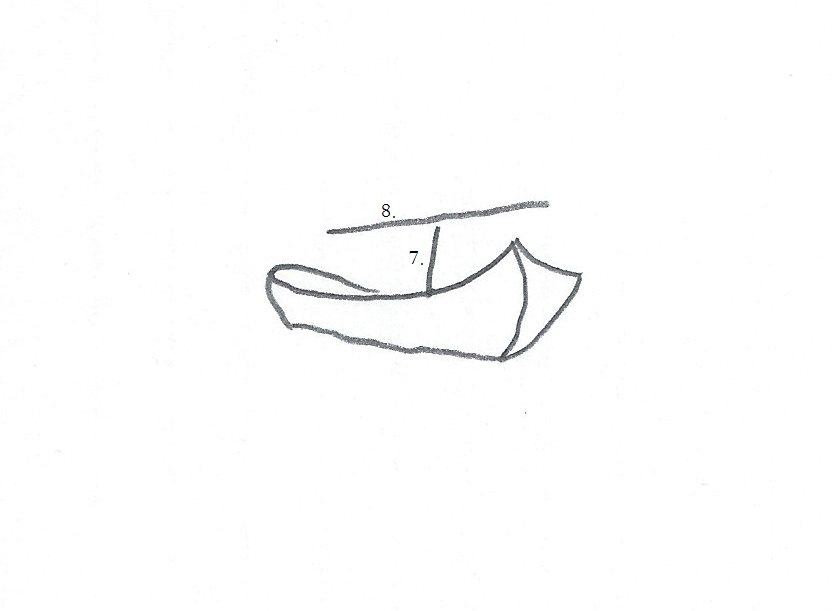
steps 7 & 8
Now you need to get your ship moving. Wind moves sailing ships, and sails harness that wind. Your ship needs sails. But, before you draw your sails for power, you need a strong foundation to support those sails. Step 7 is part of the mast. Some masts on some ships go more than 150 feet into the air. The mast supports the sails and the yardarms. Step 8 is a yardarm. The yardarm is the cross-piece that spreads the sails, it also supports the sails and keeps them in place. You now have the foundation and support to control your power.
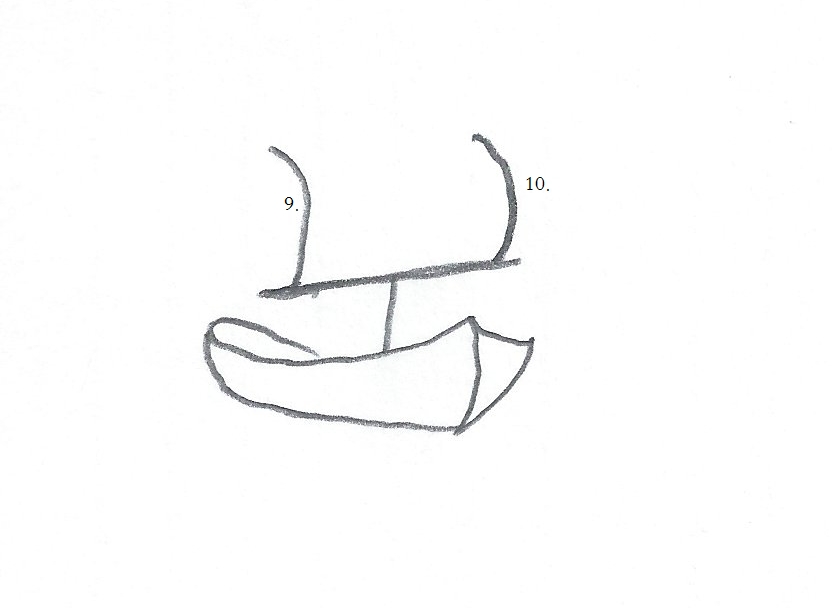
steps 9 & 10
Steps 9 and 10 define the sails. They are curved because of the wind, your ship is moving. But, most people do not know the wind can pull a ship as well as push a ship. When the wind is coming from behind a ship, it pushes on the back of the sails and moves the ship forward. However, if that were the only way to move a sailing ship, ships would have a hard time getting to their destination. Sometimes the wind is blowing against the ship. So what do you do? You steer a course a little to the left or right of the wind. As the wind passes the front of the sail, it creates a low pressure area in front of the sail, like the top of an airplane wing. This low-pressure area pulls the ship forward. Now you can steer your ship to any destination you want.
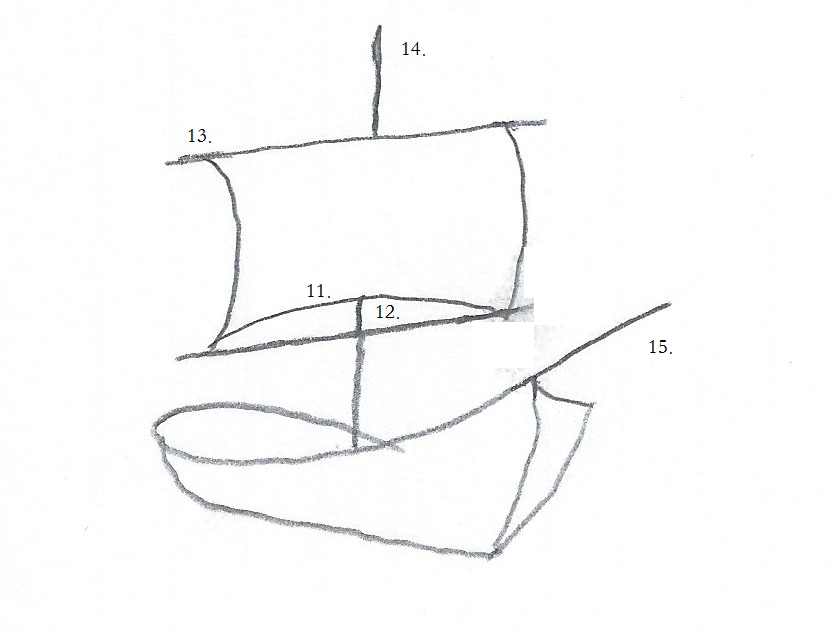
steps 11 through 15
Step 11 is the bottom of the sail curved by the force of the wind. Steps 12 and 14 are the rest of your mast. Step 13 is the yardarm where the top of your sail is attached to the mast. Step 15 is the bow sprint. On great lakes ships it is not called a bow sprint, it is called a steering pole. There you have it, your sailing ship.
A refresher before you go.
First, you get an image of where you want to go.
Then, you decide your direction.
Next, you need a firm foundation to plant your feet on.
Then, you create the form of your project.
Now, you need to power your project, and to control that power.
Sometimes forces work against you, but do not despair, adjust your course and steer toward your destination. You will prevail.
You see? You have been drawing ships your whole life. Now you can do it with paper and pencil too.
Now go out a teach someone else how to draw a sailing ship. Let’s see just how many more people can learn from John Alexander.
Thank You Mr. Alexander!
Related articles
- B9 Shipping developing 100 percent fossil fuel-free cargo sailing ships (gizmag.com)
- Parade of Sailing Ships and National Cultures in Brest (english.ruvr.ru)
- Wicklow Harbour visit by German ship (thepressnet.com)
- Sailing with Tall Ships: Journey from Savannah to New England a lesson in old-school seamanship (savannahnow.com)
- Slideshow: Tall Ships Parade of Sail a special one for Larinda (metronews.ca)
- May Of The Dead: Papercraft Ghost Ship (rovingbandofmisfits.com)
- The enduring allure of tall ships (aytacgok.wordpress.com)
- B9 Shipping developing 100 percent fossil fuel-free cargo sailing ships (nokiaphoto.wordpress.com)
- Follow your heart (intuition) for more energy [Carolyn Williams] (ecademy.com)
- Tall ships sail up Hudson River for Fleet Week (photoblog.msnbc.msn.com)
SS Bannockburn – “The Flying Dutchman of Lake Superior”

English: Photograph of the Montreal Transportation Company freighter BANNOCKBURN in the Kingston dry dock (Photo credit: Wikipedia)
SS Bannockburn
The Flying Dutchman of Lake Superior
The SS Bannockburn began life as another non-descript cargo ship designed to pass through the Welland Locks around the St. Lawrence Seaway into the Great Lakes. Sir Raylton Dixon & Company built the ship in 1893 in the United Kingdom; North Eastern Marine Engineering Co. of South Docks, Sunderland, built the steam engine.
The Bannockburn was 245 feet long (75 meters), 40 feet wide (12.2 meters), and had a draft of 18.5 feet (5.7 meters); she had a registered tonnage (cargo capacity not weight) of about 1500 tons. A rather small inauspicious ship built for the Montreal Transportation Company of Montreal, of Quebec, Canada.
The Bannockburn had a unusual profile for a Great Lakes freighter. Soon after she began her life as a Great Lakes freighter, other ship’s captains began to recognize the Bannockburn even before they could read the nameplate on her bow. For almost ten years, the Bannockburn hauled grain around the Great lakes for the Montreal Transportation Company. The ship became a common sight recognized by other ship’s captains and crews alike.
In April 1897, while at full speed, Bannockburn ran aground on the rocks near Snake Island light. No lives lost, but she was badly damaged.
The Bannockburn sank several months later in October 1897. With a cargo of grain bound for Kingston, Ontario from Chicago, Illinois, she struck the wall of the Welland Canal and sprung a leak taking on nine feet of water before she settled on the bottom of the lock. No lives were lost and the ship was refloated and repaired.
On 20 November 1902, the Bannockburn left Fort William, in what is now known as Thunder Bay, headed for Georgian Bay. She ran aground shortly after leaving Fort William and turned around heading back to port. With no apparent damage, the Bannockburn once again began her journey on 21 November 1902.
Later that day the famous Captain James McMaugh of the upbound freighter Algonquin spotted the Bannockburn seven miles southeast of his position. He estimated the Bannockburn was about eighty miles off Keweenaw Point and forty miles off Isle Royale. Captain McMaugh spotted the Bannockburn several times over the next few minutes, but eventually lost her in the fog.

English: Stannard Rock Light, Michigan, Lake Superior (Photo credit: Wikipedia)
Later that night a strong storm swept Lake Superior. At about 11:00 PM the passenger steamer Huronic identified the Bannockburn by her profile. The Bannockburn, headed for the Soo Locks, was making fine headway in the storm as the two ships passed each other. Nevertheless, the Bannockburn was never seen again during her lifetime.
The next morning the Bannockburn was reported as overdue at the Soo Locks. With the severe storm the night before this was not considered unusual. It was thought that the Bannockburn had stopped behind an island or anchored somewhere to wait for the storm to pass. As the days passed though, concern for the Bannockburn began to grow. Then on 25 November 1902, a steamship, the John D. Rockefeller, passed through a debris field just off Stannard Rock Light. No other ship was missing and there was no indication of what happened. On 30 November 1902, the Bannockburn and her crew were officially declared presumed lost. On 12 December 1902, a lifejacket from the Bannockburn washed ashore near the Grand Marias Lifesaving Station.
There had been many theories proposed for the loss of the Bannockburn including a boiler explosion. At the end of the shipping season when the Soo Locks were drained for maintenance, a hull plate from a ship was found at the bottom of the locks. Many believe this may have been from the Bannockburn. The theory continues that with a weakened hull, from the loss of the hull plate, the Bannockburn suffered a failure of its hull and sank. The ship has never been found and no one knows conclusively what happened to the Bannockburn.
Another theory as to the loss of the SS Bannockburn includes the Superior Shoal. The Superior Shoal, in the middle of Lake Superior, is a shallow area of 20 square miles. The highest point of this shoal area is only 21 feet from the surface of the lake, only 2.5 feet beneath the keel of the Bannockburn. A storm, such as the one when the Bannockburn was lost, would easily create waves greater than 3 feet. More than enough to cause the Bannockburn to run aground and sink. The Superior Shoal is also suggested as the culprit in the losses of the Edmund Fitzgerald, the Inkerman, and the Cerisoles. The last two ships disappeared on Lake Superior in November 1918.
Another shoal area, uncharted at the time of the loss of the Bannockburn, is just north of Caribou Island. The Caribou Island shoal area is also proposed as a possible grounding area for all four ships. Some believe the Bannockburn may have been swamped by waves, capsized and sank. Our only chance to discover why the Bannockburn was lost is to discover the wreck. However, even the discovery of the wreck may not explain why the Bannockburn was lost.
With any ordinary ship, this would have been the end of the Bannockburn. The ship would have disappeared into the obscurity of the past, only to periodically be resurrected by the occasional author; another small ship, lost for reasons unknown. However, the Bannockburn is no ordinary ship. Obscure in life, just one of hundreds of small ships plying the waters of Lake Superior, in death the Bannockburn has become the Flying Dutchman of the Great Lakes.
Why is the Bannockburn so revered and feared? The Bannockburn is not the first ship to disappear, only to be sighted afterwards. Submarine sailors reportedly sighted the USS Scorpion long after the ship sank southwest of the Azores. The USS Scorpion was one of six submarines, sister ships, that looked identical to each other. These other sightings were attributed to one of the Scorpion’s sister ships. The Bannockburn did not have the usual profile of a great lakes freighter. During life even at a great distance, the Bannockburn was accurately identified by her unique profile. Therefore, when the Bannockburn was spotted after her loss, there was no doubt what ship it could have been.
Some of the sightings are obvious sea stories. Sailors claiming to see the Bannockburn with skeletons on deck and in portholes manning the ship through a storm. Other reported sightings are not so easy to explain or dismiss. Some of these sightings come from men with much to lose and nothing to gain by reporting a ghost ship. Many of these sightings, over the past 110 years, have been reported in regional newspapers. When examining all of the sightings of the SS Bannockburn one group seems to rise to the surface of the unexplained. These sightings happen during or just before storms, fog, and other bad weather and seem to be warnings of danger. Most of these sightings come in the month of November as well. This group of sightings also cannot be explained as misidentifications or explained by some scientific theory.

The following is the author’s description of the photograph quoted directly from the photograph’s Flickr page. “Water fills the lock to allow our boat to travel up from the St. Mary’s River to Lake Superior. ” (Photo credit: Wikipedia)
Many sailors through the years have viewed a sighting of the Bannockburn as a bad omen. This feeling seems to accompany the more fanciful supposed sightings, such as the ones with skeletons aboard the Bannockburn. Others regard the Bannockburn more as a warning of danger, much as the ghost of the Grey Lady of the outer banks.
The Story of the Iron ore freighter Walter A Hutchison falls into this later category. Shortly after World War 2 the Walter A Hutchison was headed to the Soo Locks in a storm. Eleven hours out of Thunder Bay the crew knew they were close to shore, but could not tell how close. They had been running close to the shore, but with a loss of their electronics due to ice, they did not know how close to shore. The wind was coming out of the northwest and would have been pushing the Walter A Hutchison closer to shore. They could steer a course more to the north, but this would put the seas on the side of the ship and could cause the cargo to shift and capsize the ship so the captain continued on his course and preferring to risk possibly running aground to a likely capsizing.
The Bannockburn had been sighted on a parallel course, but with the coming night they had lost sight of her. Suddenly a rocket exploded in the night. The crew saw the Bannockburn a hundred yards off coming straight at them. The captain ordered the rudder brought over hard to port bringing the bow around to the northeast. The Walter A Hutchison wallowed in the high waves trying to put distance between itself and the Bannockburn.
After what seemed like an eternity, the Bannockburn passed safely astern of the Walter A Hutchison. The crew continued to watch as the Bannockburn then ran aground and began to rip apart at the seams. Then the Bannockburn simply disappeared. If the Walter A Hutchison had not changed course, she would have been the ship impaled on the rocks
Did the Bannockburn appear in order to warn the Captain of the rocks ahead? Then, when the Captain failed to change his course, did the Bannockburn head straight at the Walter A Hutchison to force the Captain to change his course? We will never know. I am a man of science and always look for logical explanations, but if I am ever on Lake Superior and see a three-masted, single funnel ship the logo of the Montreal Transportation Company on its stack I am going to steer wide of her and heed the warning.
Two great books on ships of the Great Lakes (I have both in my library) are “Ghost Ships of the Great Lakes,” by Dwight Boyer; and “Ghost Ships, Gales and Forgotten Tales: True Adventures on the Great Lakes,” by Wes Oleszewski.

Aerial picture of the Soo Locks between Lake Superior and Lake Huron between the cities of Sault Ste. Marie, Michigan, USA (right) and Sault Ste. Marie, Ontario, Canada (left). Whitefish Island is just to the left of the rapids. (Photo credit: Wikipedia)
Related articles
- Model maker sets sails on museum work (saultstar.com)
- Detroit Museum To Host Navy’s War Of 1812 Display (detroit.cbslocal.com)
Filed under New, ships, SS Bannockburn
The Great and The Insignificant: Part Two
The Great and The Insignificant: Part Two.
A report on the next part of my “The Great and The Insignificant” article and a preview of tomorrow’s article.
Comments Off on The Great and The Insignificant: Part Two
Filed under New, notes, ships, SS Bannockburn

 joeccombs2nd