Category Archives: history

The Way We Were ?!? Part Three


There is a scientific method for conducting research. However, everything after that is pure art. The quality and accuracy of your final analysis is dependent upon the purpose of your research. All research is conducted in one of two ways, to see what you can find, or to look for information to support what you already know or believe.

The former is the most time consuming, but if you are after accuracy this is the way to go. The latter is the quickest way to conduct research, and the least accurate because you can disregard any information that does not support what you know or believe. To look to see what you can find is a very difficult way to conduct research. It is innate to see and understand things through the prism of your own experiences, a tendency you must fight if you want an accurate snapshot of that moment in time you are researching. To do accurate research you must look for data with a totally open mind, ignorant of everything you knew previously to your research. Even the best of us fail at this from time to time.

Even when you have done your best it is still possible to miss important data. As I was writing this I saw an episode of “Pawn Stars” that proves this point. A gentleman brought in an authentic civil war pistol which was engraved with the original owners name. A black civil war officer with the 1st Louisiana Native Guard. The customer said he was a Confederate officer. They called in an historian (“Mark”) to verify the story and a gun expert to verify the authenticity of the gun and the engraved name. The gun and the engraving was authentic. The historian confirmed the original owner was a black civil war officer, but he said he was a Northern officer and that there were no black Confederate officers. He said the 1st Louisiana Native Guard was a Yankee unit formed after General Butler captured New Orleans.

Well, yes and no. The 1st Louisiana Native Guard was formed on 27 September 1862 (New Orleans fell in April 1862). But, that was not the first 1st Louisiana Native Guard. The first, 1st Louisiana Native Guard was formed on 2 May 1861 and disbanded by the Louisiana state legislature on 15 February 1862. This earlier unit was a Confederate unit. Many men were members of both the Confederate and the United States unit, which had the same name, including the officer who had originally owned the pistol. So, despite what the credentialed historian thought, the 1st Louisiana Native Guard had also been a Confederate unit, meaning the Confederacy did have black officers within that unit. As I said, it is easy to make mistakes in research.

Now. Back to our story on Andrew and Silas Chandler ( http://video.pbs.org/video/2152291788/ ) and my analysis. We will start at the beginning of this series. Dr. Berry said that no black men served in the Confederacy as soldiers, it was illegal. She also said that Silas was not a freedman, it was illegal. Yes and no, Silas was not legally free, and probably was not freed until the end of the war. Now those who disagree with Dr. Berry may believe that she is part of the politically correct contingent which is trying to rewrite history. I disagree with this evaluation of Dr. Berry’s motive. If you look at Dr. Berry’s resume it would be hard to imagine her saying anything else.

Dr. Berry has spent her professional life in public service and in education (including public appearances, published articles, papers, and books, and consultations that go with those professions). In public service one of the jobs she had was on the Civil Rights Commission (read law) and in education she is of the History of American Law and the History of Law and Social Policy. So, you see, throughout her professional life the doctor has been concerned with the law, and quite naturally looks at history through the prism of what the law says. So, based on her personal experiences, she is absolutely correct. However, in real life, the law is rarely followed so strictly by everyone.

One of America’s greatest military generals quite often found himself in deep trouble for not doing what he was supposed to. At the end of World War Two, General Patton was in charge of the occupation army in Germany and got into quite a bit of trouble for not following the law. The United States Congress had passed “de-nazi-fication laws.” Those laws barred former members of the Nazi party from being in public service or working for public utilities and services. Patton ignored those laws, and when questioned he reportedly said that when he was supplied with the people to run the trains, phones, and electrical plants who were not former members of the Nazi party he would use them, until then he would use the people he needed to keep things running. They relieved him of his command, but the war was over. During the war, they chastised General Patton and punished him, but they always promoted him, gave him another army to command, and sent him right back into battle, which was where Patton wanted to be.

Another of the often used comments of those who say blacks did not serve in the army, is that blacks served as servants, cooks, they worked in supply, and helped as medical orderlies, so they were not part of the army. Of course, most of the people making that claim never served in the military. For centuries we have action reports of battle where these “non-military” people are used in combat. It was towards the end of the 20th century before blacks were allowed in jobs other than support roles in the military. In the submarine service the crews are much smaller than on surface ships. Due to crew size, every man in a submarine crew must learn every job on board the submarine. During World War Two, submarine service attracted many blacks in the navy, expressly because of this. For the first 50 years of the submarine service this offered the only path blacks had to learn technical skills in the military. On the submarines I served on, our support people were also part of our battle stations. They worked out fire control data for the torpedoes, they help load torpedoes, stood watch in sonar with the sonar techs and (like all members of a submarine crew) were also part of the damage control parties. During routine watches these men could qualify for almost any watch they wished to stand: lookout, helmsman, quartermaster, sonar operator, as well as others. When in battle commanding officers will use whoever they have available to try and win a battle … the laws of politicians be damned. And when a man proves himself in battle, often those men are used more regularly.

Confederate troops were almost always outnumbered and so it stands to reason freedmen and slaves would eventually be used as combat troops no matter what the law said. But, of course, since it was illegal, looking at Confederate action reports would not reveal the use of blacks as combat troops. No officer is going to write and sign a report that could result in charges being brought against them. So, the best place to find evidence of blacks used as combat troops is not in the Southern action reports. The best place to find primary source evidence of blacks being used by the Confederates as combat troops, is in the action reports of the enemy, written by officers in the US Army.

As for the many web sites that talk on this subject, most are partisan at best. One good example of this is a web site that quotes the 65,000 blacks fighting for the Confederacy and claims the person using this must have made it up and that they have no idea where such a preposterous number could have come from. Actually the man who originates this number explains in detail how he arrived at the number. He calculated this number from the action report of one Union officer in one battle who stated there were 3,000 blacks fighting with the Confederates. Then calculated the percentage of blacks in the Confederate ranks for this one battle and calculated what the number would be if that same percentage represented the number of blacks in the entire Confederate Army. His math was correct but his method flawed. And the first web site was being dishonest in an effort to discredit anyone claiming blacks fought for the Confederacy.

Books written about the war since the war are at best secondary sources. When doing research, secondary sources can point the way for the direction of your research, but primary sources should always be used to base your research upon. In this case the best primary source reference on the civil war is The Official Records of the War of the Rebellion (commonly referred to as the “OR”)

Beginning in 1864 (after April 1865 for Confederate records) the War Department of the United States began collecting first-hand accounts, orders, reports, maps, diagrams, and correspondence (created as the events were happening) from the war departments of the United States and Confederate States. They were published by the United States government, including a separate series for the Union and Confederate navies.

The OR was published as 128 books organized as 70 volumes with over 130,000 pages, and more than 1,000 maps and diagrams. The last of the books was published in 1922. This is the best primary source information available, though it is obviously not complete as some of the material would have been accidentally or intentionally destroyed during the war.

The best evidence to support blacks fighting for the Confederacy is not a book someone wrote 100 years after the war. The best evidence is to take a Confederate unit that supposedly use blacks in combat and then look for the action reports of the Union officers who fought against that Confederate unit in the many battles that specific Confederate unit fought in. What I found was a consistency in the reports of blacks being used in some units. The numbers would not be accurate as the Union officer was estimating while fighting in combat. But an officer stating their were 3,000 blacks in battle against him may be off by several hundred, but certainly would not mistake 3 or 30 for 3,000.

It is important to look at several battles, because in an emergency a commanding officer would use anyone who could hold a gun to keep from losing a battle. We are not looking for that emergency, but we are looking to find out if blacks routinely fought for the Confederacy, even though it was illegal.

I have my own copy of the OR, but if you would like to do your own research using these series, you can access them at most libraries, or you can now read them online thanks to Cornell at this link http://ebooks.library.cornell.edu/m/moawar/waro.html

One of the other claims made to refute the idea that blacks fought for the Confederacy is that they had no choice. Since they were slaves (in this argument I guess the existence of freedmen is ignored) they were fighting because they were told too and could not refuse. The argument also ignores the possibility that some of the slaves may have chosen to fight for the Confederacy if they were given the choice. Looking at this argument from our modern time it does seem logical. But, to arrive at the accurate facts of the matter we need to look at this argument from the mind-set of people in the mid 19th century.

In 2014, it has been four decades since we had a draft, in the United States, we have an all volunteer military – no one can be forced to serve in the military. But before that, in a time of war large percentages of the fighting force were drafted. They had no choice. They could show up for military service or go to jail, just like Muhammad Ali in 1967.

No one would think of not honoring a Vietnam veteran or a World War veteran as a veteran simply because they were drafted. So why would anyone refuse to honor a Civil War veteran as a veteran? Two answers immediately come to mind. The first reason, looking at the mid 19th century and judging it by our modern opinions, beliefs and ideals; instead of judging it with mid 19th century opinions, beliefs, and ideals. The second reason, is as old as ancient Egypt, pure politics.

Being accurate is difficult, but always should be the goal of any one doing research. Even the most well intentioned person can make an innocent mistake, but not all errors are unintentional mistakes or innocent.

If you do make a mistake, claim it as soon as possible, people will place more faith in your work. I hope you will look at the OR sometime, just to see what is available if nothing else, it is indispensable for anyone wanting to do serious research on the civil war.

I will be tackling more of the controversial issues of the Civil War this year.
1 Comment

Filed under Cival War, history

The Way We Were ?!? Part One


There are two historical topics which I enjoy studying and am loathe to write about, ironically for the same reason. The first is RMS Titanic, and the second is the American Civil War or as it is known in the South, The War of Northern Aggression. The reason I do not like writing on these two topics is that they are fields of historical research where emotional attachment and opinion override evidence and logic. It is in these two fields of historical research where people make the strongest assertions that their opinion is not opinion but fact, and where the discourse between those of different opinions is the most disrespectful and caustic – at best. When all else fails, the intelligence of opponents is attack as if, you guessed it, these attacks (opinions) were also established fact demonstrated by evidence instead of what they really are, which is dogmatic opinions. And what are those opinions, really? In most (but not all) cases they are an attempt by someone losing an argument to bully an opponent into silence, or someone content to find “authorities” they agree with to mimic instead of researching the material themselves. This last group moves to the attack the quickest depending on how long their memory is. The fewer words of their hero they can remember, the sooner they launch into personal attacks.

Today I wish to discuss black (negro, colored, people of color, Afro-American, African-American, or whatever term your generation uses) who are veterans of the Confederacy. I am sure I will have something to say to upset everyone, at least a little bit.

I remember a long time ago I had an English teacher talking to me about essays. She said it is hard to prove a negative. You know what I mean, bigfoot doesn’t exist, space aliens don’t exits, God doesn’t exist (I’m not taking sides one way or the other on these, they are just examples). So, I am going to start with the negative “… did not happen,” side of this story and then move on to the “… it did happen” side of the story, and end with my analysis. Like I said, I’ll probably upset everyone a little, but if you read my articles two years ago on how I do research then you will not be surprised by my approach.

What got me started on this is an episode of The History Detectives on PBS. A show I thoroughly enjoy. You can go to www.pbs.org and watch this particular episode for yourself (aired October 11, 2011 : episode title “Chandler Tintype, Hollywood Indian Ledger, Harlem Heirs). It is one of the few programs on TV that I really enjoy, and I also like each of the show’s hosts. They all do very good work and their support team is very good at what they do. Wes Cowan hosted the segment I am going to use as my intro into this topic. Now, I need to be fair to Mr. Cowan, he is an appraiser and auctioneer, not a credentialed historian. But he does have a good foundation in history for his work, and (in my opinion) does an outstanding job on the show.

For those who do not know, viewers contact the show about an object they have. An object they know nothing about, someone told them about, or just something they want to know about that is or could be historical. The hosts then track down the historical evidence using primary source material to tell the owner what they have.

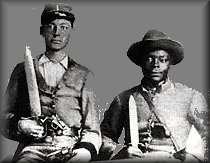
The part of this particular episode we are interested in is the first one and is about a Civil War photograph (not particularly rare), of two confederate soldiers (a little more rare), one of them black (ok, more rare), sitting side by side. Yup, this is very rare Andrew (white guy) and Silas (black guy) are sitting side by side. Normally even the union photos of blacks and whites always show the black man in a subservient position (standing behind the white guy or holding the reins of the horse the white guy is sitting on), never side by side as equals would be. The descendents of the two men explain the family history states the one man gave the other his freedom before the war started, and that they fought together in the same unit for the Confederacy.

Andrew (left) Silas (right)

Andrew (left) Silas (right)

There was also other questions they wanted answers to, but we are going to confine our discussion to Silas’ service in the Confederacy. So, these are the questions we will examine:

  1. Was Silas given his freedom before the war started?
  2. Did Silas fight as a Confederate soldier?
  3. If Silas did fight as a Confederate soldier, was he doing so as a slave against his will, or voluntarily as a freed man?

Mr. Cowan went to Dr. Mary Francis Berry, University Of Pennsylvania Historian, (who teaches the History of American Law, and the History of Law and Social Policy. She also advises students in African American History) to answer these questions.

Dr. Berry shared, quite correctly, there were free people of color who joined the militia at the beginning of the war, but those units never saw battle and were disbanded by the state legislatures not long into the war. She went on to say that Silas was not freed on the eve of the war, because in Louisiana it was illegal to give slaves their freedom by 1856.

Mr. Cowan and Dr. Berry go on to talk about the “myth of black Confederates.” When Mr. Cowan tried to say it not possible for Silas to fight for the Confederacy, Dr, Berry said it would be inaccurate to say there was no way they could not have fought, but they were not accepted by the Confederacy as soldiers. Blacks were used in supporting roles for the Confederacy (cooks, teamsters driving supply wagons, servants, construction and other support roles). It was also said that since these men were slaves, they were forced into service and did not have a choice in the decision of whether they would support the Confederacy or not. There support of the Confederacy was, in other words, compulsory.

Next, Mr. Cowan used the Civil War Roster web site, which is maintained by the National Park Service. This site listed Andrew was listed, but Silas was not listed. Mr. Cowan used this to support his conclusion that Silas did not fight for the Confederacy. He also checked the 1860 census for Chickasaw Parish Louisiana and found no listing of any freedmen in the Parish (Louisiana has parishes instead of counties). The pension that Silas received as a servant (slave) in the service of the Confederacy was explained as part of the “Lost Cause” justification common in the late 19th and early 20th century in the South as an attempt to justify the Civil War.

Next week we will discuss the side of the argument that there were freedmen and slaves who fought for the Confederacy. The third part of this series will be my analysis of the pro and con evidence given by the two sides.

Comments Off on The Way We Were ?!? Part One

Filed under Cival War, history, Southern

Veteran’s Day 11 Novemeber 2013


Monday, Veteran’s Day, I am taking a vacation day. It’s one of those ‘family things’, my step-dad did it and so do I (we are both veterans). Panera Bread is offering current and veteran members of the military a lunch on Panera Bread, wear your uniform, show your ID card or discharge papers and lunch is on them. Many places have offers to those who are and have served. It wasn’t always like that.

I have a book in my library written by a college professor in which he answers questions from people of an opposite political opinion than his. I have not forgotten his name or that of his book’s, I am just not promoting them. I want to mention two of the questions he answered.

First, he addressed Vietnam veterans being spit on when they returned from Vietnam. He said this supposedly happened, but there is no proof it ever happened, not even once. I went in the navy five years after Vietnam. I remember being called baby killer and someone spitting on me, and we were treated a lot better than those men and women five years before us. Bill, my step-dad and a Vietnam veteran, he was spit on and worse. Sorry professor, you got that one wrong.

Second, he addressed the accusation that people of his political opinion are weak or even anti-national defense. The rest of this chapter was spent making the point that man-made global warming (the book was published before the term was changed to “man-made climate change” to cover downward changes in temperature as well) is a national defense issue and since his side is very strong on man-made global warming, then his side is actually very strong on national defense. Professor, when people point a finger at you and say, “You are weak on national defense” I may not know the specific issue they are thinking about, but I can tell you it is not climate change, they already know where you stand on climate change.

You see Vietnam Vets, like my step-dad and some of my friends; they were treated pretty bad when they came home. My group, those of us who served between 1975 and 1991, we were pretty much ignored except by a few hostile people left over from Vietnam protesting days. I remember when Operation Desert Shield started (when we began deploying people for the first Gulf War) the anti-war protests started again. There was a backlash against the protestors across the nation by the middle and lower classes of our country. Those from the Vietnam protests days, who were organizing protests for the Gulf War, were shocked by the backlash; they did not see this during their earlier Vietnam protests. They quickly came out with statements that they were against the war, but supported the troops. The public did not believe them, and though they continued their protests, they tuned it down a little bit.

Those vets, the first Gulf War vets, were treated pretty good by the people when they came home, and today’s veterans are treated even better (though the United States government never has done a very good job supporting veterans). I support the better treatment, the way the men and women were treated when they came home from the Vietnam War was a national disgrace. I saw their treatment with my own eyes, and no book by a college professor will ever convince me I did not see what I saw.

Here is my deal. I do not mind the protests, it is an expression of freedom of speech, it is our constitution in action. When I joined the navy I swore to obey the President, but I swore to protect and defend the constitution from all enemies. I understand why some people mistreat veterans, to them the members of the military are the war (some of them even believe people in the military like killing people) and they feel justified in their actions. But, I’ll keep my opinions on those people and their actions to myself.

I know people (some are friends of mine), who say war is not necessary there is always another way. There is always another way and I am glad for those people who believe this, I encourage them and would like nothing better than to see all the people of the world believe this one day, then maybe we could end wars.

I decided to serve in the military because there are some wars that have to be fought. You talk with men and women who have served and you will receive many reasons for why they volunteered. Bring up “defending those who cannot defend themselves” and without exception every one of those veterans will agree. You can hold up Hitler or any other person who needs to be stopped and I will agree with you they should be stopped, but not by war. They should be stopped by other means.

The people in Hitler’s concentration camps and gashouses, the Kurds gassed by Sadam Hussein just before the second Gulf War, the victims of genocide in Bosnia, Africa, Central and South America, you cannot protect them with sanctions and rhetoric. These are men, women, and child tortured and murdered while we try other means. The longer we try those other means the more victims are created.

The problem with wars are the leaders and celebrities both for and against, they are only concerned with winning a political argument. The people who stand to make money from war get their “boys & girls” on the hill to wave the flag and talk about patriotism. Their political opponents scream about blood for oil or whatever happens to be the expeditious slogan of the day; during Bosnia, the opponents stated the president was trying to get attention off his scandals and the attempts to impeach him, by going to war. The people who propose war rarely do it for the right reasons, to defend those who cannot defend themselves. Those who oppose war too often ignore those who cannot defend themselves – out of sight, out of mind.

Most of the wars my country has fought in the last 100 years should not have been fought, and there are many other wars that should have been fought (to defend people who could not defend themselves), but were not fought.

To me the worst part of those wars we do fight is what we do to our men and women fighting those wars while they are fighting. Once again, it is all politics. You see the losing side of the political fight, republicans during Bosnia and democrats during Iraq, write “rules of engagement” that the military must obey while fighting the war. The political opponents are usually responsible for more American military blood than our enemy is. In Afghanistan a US soldier brings his/her weapon to bear on two people operating a mortar lobbing shells at him/her, but they are not allowed to shoot them because the attackers are dressed like Afghan civilians and therefore (in the mind of politicians in the military and in Washington DC) may actually be an innocent civilian or there may be other innocent civilians standing near them. (The enemy know this and so they ensure all combatants are dressed like civilians.) So, more American women and men die needlessly thanks to politicians and generals back in Washington DC.

In Iraq, our enemy know that if they attack us from inside a mosque they can shoot at our soldiers all day and fear no return fire. Why? Because those same politicians do not want mosques damaged (it’s ok to damage churches and synagogues though), they are afraid our enemy will think we are fighting a religious war, a war against Islam. Except the political, military, and religious leaders of our enemy have already declared this war to be a religious war against all non-Muslims.

News flash to those in Washington DC! If the only time a mosque is damaged by our troops is when they are returning fire from our enemies, the Muslim moderates (our politicians claim they are pandering too) will notice this and realize we are not targeting their mosques. Not only does this rule of engagement kill many of our own men and women but also it presumes that if you are Muslim you are too stupid to notice the difference between damage done to a mosque while in battle and a mosque that is destroyed in the absence of a battle simply because it is a mosque.

I think the next time these politicians propose a war for money (republican or democrat) or the next time they (republican or democrat) oppose a war that needs to be fought to defend those who cannot defend themselves, we should take both sets of politicians give them clubs and lock them inside the capital building in Washington and let no one out until only one is left standing. I think there would be fewer wars and fewer genocides around the world. Yes, I am a veteran. Yes, if the need arises again and if I think I will be useful, I will put on a uniform again. Yes, if I have to, I will kill people in war. No, I do not like war. No, I do not like killing.

You want to see a smile on my face? Flash forward thirty years, I am walking with my granddaughter:

“Grandpa Mommy says you are a veteran. What’s a veteran?”

“A veteran is someone who served in the military. Do you understand Sweetheart?”

“Yes grandpa.”

“Grandpa?”

“Yes dear.”

“What’s a military?”

You help make that conversation possible and you will see a smile on my face that took eighty years to create, a smile like I have never had before. And the tears that will be streaming down my face will be from a joy so intense no words could describe it.

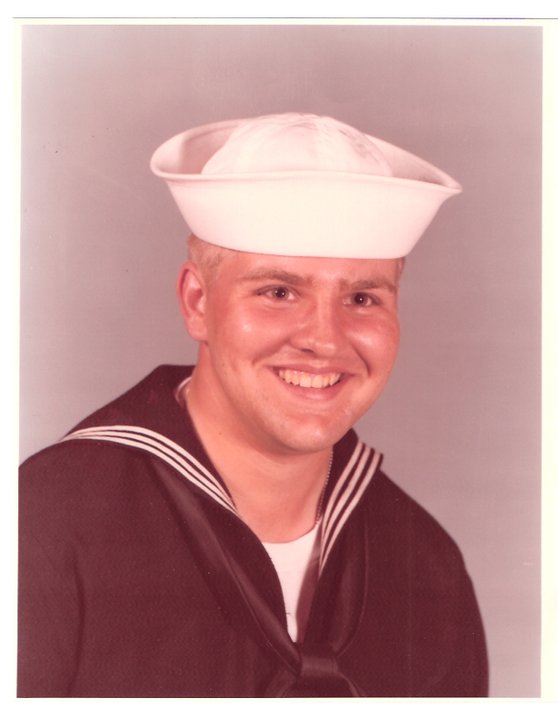
Joe C Combs 2nd First offical navy portrait November 1980.

Joe C Combs 2nd First offical navy portrait November 1980.

2 Comments

Filed under family, history, navy, thoughts

Just A Man Who Was Trying To Be Decent (Bessieres Part 5)


The triumphal parade of the Grande Armée in th...

The triumphal parade of the Grande Armée in the Prussian capital of Berlin on 25 October 1806. (Photo credit: Wikipedia)

From March 1802 to 18 May 1803, Europe was at peace, the longest peace during the Napoleonic era. The Bessieres’ would be married for eleven and a half years, until Jean’s death in battle in May 1813, yet even this 15 month peace would not allow him to be home with his bride.

Though, Napoleon had wanted Jean to marry his sister Caroline Bonaparte he was quite happy with Jean’s choice. Jean and Marie were a perfect match. Marie (the name she went by instead of her first name Adele) was very beautiful and with the same strong character, charm and manner of her husband.

The couple was a great social success everywhere they went. Marie became a close friend and confidant of Josephine. This friendship drew the Bonaparte and Bessieres families even closer together. When Napoleon divorced Josephine, it made the friendship difficult at times, yet true to their character and sense of fidelity, Jean and Marie never wavered in their affections and loyalty to both Napoleon and Josephine.

The War of the Third Coalition would last until 1806, to be followed by the Fourth, Fifth, and finally the Sixth Coalition War. It was during the War of the Sixth Coalition that Marshall Bessieres was killed followed two years later by the final defeat of Napoleon at the battle of Waterloo. Napoleon said, “If I had had Bessieres at Waterloo, my Guard would have brought me victory,” this point has been argued by historians. I am not sure if Waterloo could have been a French victory, even with Bessieres at the battle.

What do I believe? If Bessieres had been at the battle of Waterloo, even if the French had been defeated, it would not have been the rout that destroyed the French army. The French may have lost, but Bessieres’ unbiased advice on the battlefield would have allowed Napoleon to conduct an orderly retreat that would have preserved the French army and Napoleon’s throne. But, I am getting ahead of myself.

In 1803, the War of the Third Coalition began between Great Britain and France. Napoleon’s actions in Italy and the execution of the Duke d’ Enghien (which Bessieres was against) brought Austria and Russia into the war in 1804-05. In the Ulm campaign (August to October 1805), an entire Austrian army was captured. Then came the battle of Austerlitz in December, outnumbered by the Russian and Austrian allies, Napoleon soundly defeated the allies effectively ending the Third War of the Coalition. Once again, the friends Murat and Bessieres were in the thick of the fighting, helping to win the day for France.

Napoleon at the battle of Austerlitz, by Franç...

Napoleon at the battle of Austerlitz, by François Pascal Simon, Baron Gérard (Photo credit: Wikipedia)

The War of the Fourth Coalition happened without a period of intervening peace. The Fourth Coalition was basically the Third Coalition without Austria and the addition of Prussia. This was to continue for the rest of Bessieres’ life and continue after his death until the final defeat of Napoleon at Waterloo. Jena, Auerstedt, Eylau, Friedland, Somosierra, Corunna, Aspern-Essling, all of these and more would see the victorious and dashing friends Murat and Bessieres working hard for French victory.

At the battle of Wagram (July 1809) a cannonball knocked him unconscious and killed his horse, the Guard wept thinking Bessieres had been killed and charge into battle vowing revenge. Napoleon later told Bessieres, “That was a fine shot, it made my Guard cry.”

Napoleon during the battle of Eylau

Napoleon during the battle of Eylau (Photo credit: Wikipedia)

At Elyau the Austrians technically defeated Napoleon, but they let him get away with his army. Partly because Bessieres led the Imperial Guard in a frontal assault against the main Austrian attack force at a vital point in the battle. Not once but several times Bessieres led his men in a suicidal attack. The last year and a half of Bessieres’ life was spent constantly in battle. It is miraculous that Bessieres did not die earlier than he did. At this time in the Napoleonic Wars, the allies were getting better because of experience from the earlier defeats, and the French were slowly losing their best and most experienced men through combat deaths.

Bessieres was the first to recommend they leave Russia, even before they arrived at Moscow. In Moscow, the French found the city burning and deserted by the Tsar and his army. Bessieres took his own food from his own table and gave it to hungry Muscovites and Russian children. On the retreat from Russia in October 1812, 6,000 Cossacks surrounded Napoleon’s headquarters on three sides. Without concern for his own safety (as Bessieres always was in battle) he led a charge of the Imperial Guard, running off the Cossacks, killing thousands of Cossacks, and rescuing Napoleon.

Battle of Weissenfels 1813 by Girardet

Battle of Weissenfels 1813 by Girardet (Photo credit: Wikipedia)
 This image shows the death of Bessieres

The morning of Bessieres’ death, he told an aid he was eating breakfast because if the enemy got him that day he did not want to die on an empty stomach. Sixteen years of war and eighteen months of continuous battle were taking a great effect on the great Marshall. Apparently, he was beginning to believe own combat death was inevitable, that can be dangerous for any person in combat. But, who could he confide in? His wife was thousands of miles away for much of their married life and all of  1812 and 1813, Napoleon and his men not only counted on his calm, cool, courage in battle; they depended on. If Bessieres showed his fear it could have been disastrous for the Imperial Guard.

There was no one Bessieres could turn to for comfort, so Bessieres took a mistress. Not what you would have expected considering his reputation and the deep love he had for his wife. However, even in this one vice, Bessieres’ character was above that of the men and women of his day. Affairs were common in this day, even Napoleon and Josephine both had a long lists of lovers. Bessieres though did not follow the norm of inviting woman after woman into his tent. Bessieres took one mistress, for whom he paid all of her bills. An expense his contemporaries all avoided by going through lover after lover. Even in his one vice, there was a certain amount of honor.

At the battle of Borodino (7 Sep 1812) the Russians and French were both decimated, but there was no clear-cut winner. Napoleon is criticized for not committing his reserve to bring about a victory. All of Napoleon’s Marshalls wanted to commit the reserves except Marshall Bessieres. Bessieres did not argue the point, he made one simple statement to Napoleon, “But, Sire, you are 700 leagues (2,100 miles) from Paris.” If Napoleon would have used the reserve and not destroyed the Russian army, he would have had a French army that was worse than decimated, deep inside an enemy country facing an enemy army thousands of miles from home. Bessieres was correct and Napoleon knew it.

Bessieres is criticized by historians as a capable commander, but a failure as an independent commander due to his conservative nature. I would like to point out though, that when historians look at a battle they are looking at that one battle with the knowledge of how it and all the following battles ended. They also tend to look at each battle as an isolated affair. Bessieres’ advice and actions were always tempered by the knowledge that he did not know what would come tomorrow and the knowledge that if the army was utterly destroyed, France’s enemies would own the streets of Paris (which they eventually did).

Bessieres is also criticized for the one battle where he was placed under the command of his old enemy Lannes. Bessieres’ supporters say that Lannes still had a grudge against Bessieres, and that his orders to Bessieres were not designed to win a battle, but to embarrass and humiliate Bessieres. The historians say, “Posh, Lannes was happily married and his grievance with Bessieres was old news happening years ago.” Really? Maybe the
historians should read the diaries and memoirs of the aides of both Bessieres and Lannes who witnessed this whole affair. A good place to start is with the memoirs of General Marbot. General Marbot was one of the men ordered by Lannes to deliver Lannes’ orders to Bessieres. Marbot had no doubt that Lannes’ purpose was to insult and humiliate Bessieres. Marbot states that there was no doubt of this at the headquarters of Lannes and Bessieres. He goes on to describe the scene when he gave the orders to Marshall Bessieres.

I have already printed the letter Napoleon wrote to the Duchess Bessieres on the occasion of the Duke’s death. When Marshall Jean Baptiste Bessieres, Duke of Istria died he left huge debt. Napoleon created a pension for the great general’s widow to insure she was taken care of.

In his book, Travels in France during the years 1814-1815, Archibald Alison wrote of spotting General Blucher leaving his apartments in Paris (which Blucher rarely did). Alison followed the General to the church of the Invalides, where he went to a grotto in the church where the body of Bessieres lay in state surrounded by flowers his widow brought to the church daily for her husband, this was two years after his death. General Blucher paid his respects to his former adversary (Bessieres beat Blucher in 3 out of 4 battles they faced each other in) and then left.

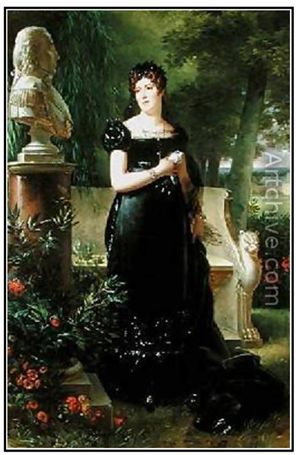
This is a reproduction of an original portrait showing Madame bessieres, dressed in morning with the bust of her husband that is in the hall of heros in paris. Reproductions are available at http://www.artchive.com/web_gallery/R/Robert-Jacques-Francois-Faust-Lefevre/Portrait-of-Madame-Bessieres.html

This is a reproduction of an original portrait showing Madame bessieres, dressed in morning with the bust of her husband that is in the hall of heros in paris. Reproductions are available at http://www.artchive.com/web_gallery/R/Robert-Jacques-Francois-Faust-Lefevre/Portrait-of-Madame-Bessieres.html

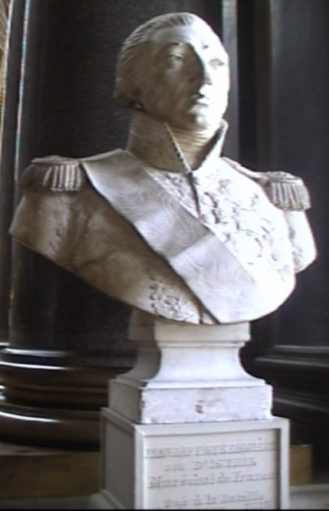
The Bust of Jean Baptiste Bessieres, Duke of Istria, Marshall of France. This bust is just inside the hall of Heros in Paris to the right of the entrance.

The Bust of Jean Baptiste Bessieres, Duke of Istria, Marshall of France. This bust is just inside the hall of Heros in Paris to the right of the entrance.

There are so many more instances that I am prepared to give to demonstrate the greatness of this simple man. A simple man who loved his country, his friends, his family, and his wife. However, I will leave you with the words of Napoleon as he neared his own death in exile.

“If I had had Bessieres at Waterloo, my Guard would have brought me victory.”

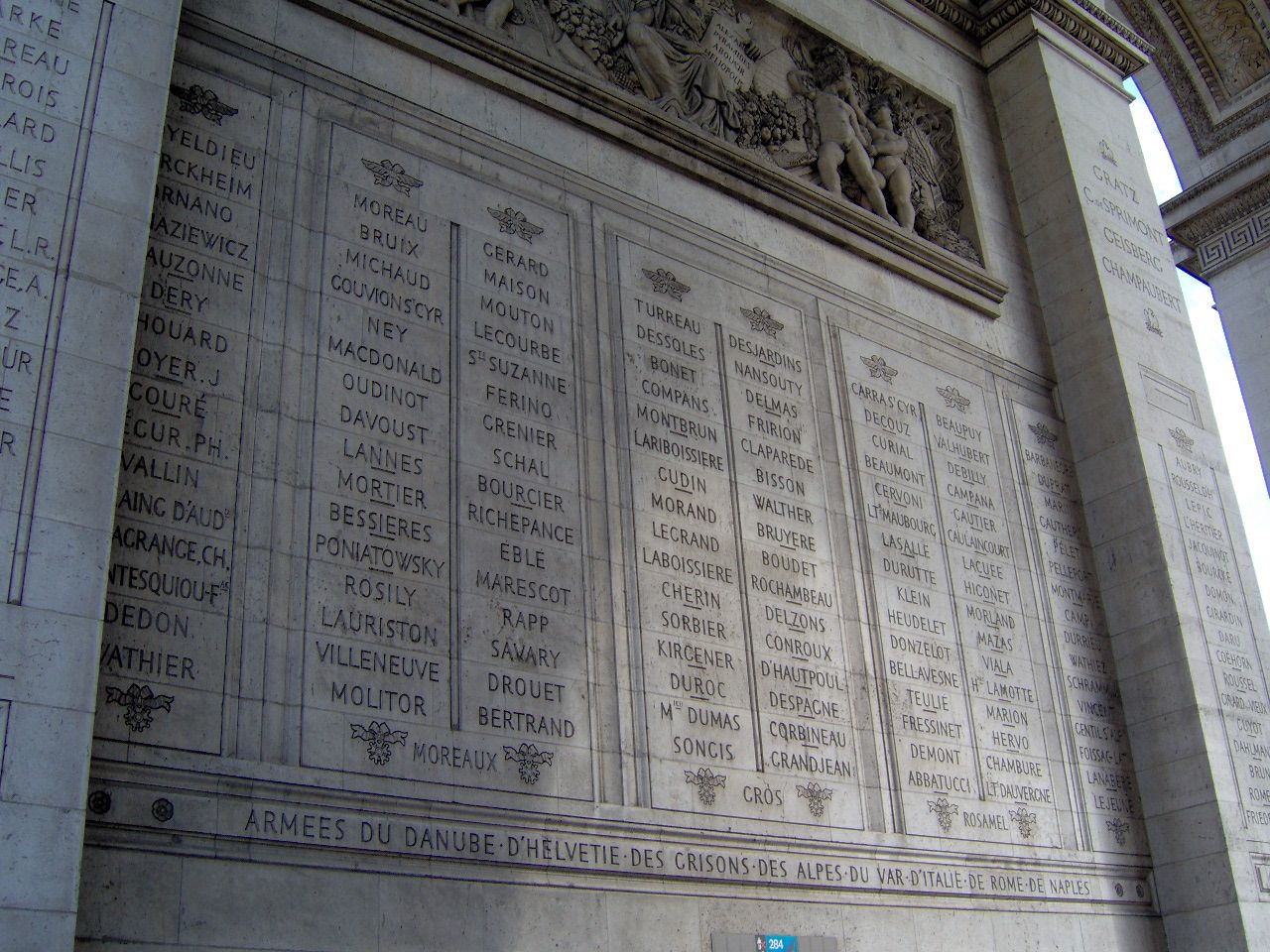
Jean Baptiste Bessieres' name is on the east wall of the Arch De Triumph. Second col. from the left third stone up from the bottom. The line under his name denotes he was killed in action. His younger brother is on the South wall without the line because his brother survived the wars.

Jean Baptiste Bessieres’ name is on the east wall of the Arch De Triumph. Second col. from the left third stone up from the bottom. The line under his name denotes he was killed in action. His younger brother is on the South wall without the line because his brother survived the wars.

Comments Off on Just A Man Who Was Trying To Be Decent (Bessieres Part 5)

Filed under history, New

Napoleon’s Best Friend (Bessieries part Four)


Jean Baptiste Bessieres Duke of Istria Marshall of France

Jean Baptiste Bessieres
Duke of Istria
Marshall of France

The goal of the Egyptian campaign was to weaken Britain, for at the heart of it all the Napoleonic Wars were one campaign between two nations, France and Great Britain. Great Britain feared that a successful France (without a monarchy) would eventually lead to the demise of monarchy and the hereditary privilege of the upper classes in Great Britain. France’s great fear was the subjugation of France to Great Britain.

There was a large contingent of scientists and artisans with the Egyptian expedition, but the scientific aspect of the expedition was secondary to the military goals. With France in control of Egypt, the British trade route from the Mediterranean to the East Indies would be disrupted. This was to be followed by a military expedition to India from Egypt to unite with French allies and disrupt the British trade routes to India.

What the governing Directorate in Paris wanted was to remove Napoleon from the center of power in France, just as they had sought to do with the Italian Campaign. After the successful Italian Campaign Napoleon was even more popular in France and even more ambitious which caused the Directorate to fear him even more than they had before.

On 19 May 1798, Napoleon departed Toulon, France with 40,000 soldiers and 10,000 sailors. On the 11 June, the French forces captured Malta. On 1 July, Napoleon landed in Alexandria, Egypt.

While in Egypt Bessieres again distinguishes himself at the siege of Acre (19 march – 20 May 1799) and the battle of Aboukir (25 July 1799), this last battle saw him promoted to general of a brigade. While in Egypt Bessieres and Napoleon became good friends, a relationship which would only grow stronger. It was during this time that the War of the Second Coalition had started. France was suffering losses in Europe and the French people were becoming tired of the dictatorial leadership of the Directorate. Napoleon saw this as his chance.

Napoleon announced he was going on a voyage on the Nile Delta, while in reality he was returning to France to seize the government. On 23 August 1799, Napoleon left Egypt for France with only his most trusted men, of which Bessieres was chief among those.

The small cortie arrived in France in September. Abbe Sieyes, one of the five directors of the Directorate, was planning a coup to stop the Jacobins. Sieyes was planning on Napoleon’s popularity with the people to advance the coup and place himself at the head of France. Napoleon planned a coup within the coup using his small group of select, trusted officers. Bessieres was a member of this small group and helped Murat, Lannes, and Marmont secure the support of the Army for Napoleon in the coup d’état.

Napoleon wanted a wedding between Bessieres and his sister Caroline Bonaparte, However, Bessieres preferred his childhood sweetheart. Then Napoleon decides to wed his sister to Murat or Lannes. Murat and Bessieres were great friends and Caroline preferred Murat, but Napoleon preferred Lannes. Bessieres intervened and influenced Napoleon to choose Murat, and Lannes became a lifelong enemy of Bessieres. There would be many clashes between Bessieres and Lannes in their future. Lannes would go on to wed and have a happy marriage with his wife (this was his second wife), but the bitterness with Bessieres would only grow.

On 11 November, the Consular Guard was created with General Bessieres as its second in command. By 14 June 1800, during the battle of Marengo Bessieres, leading the Consular Guard, and Kellermann, leading the Dragoons, once again saved the battle for France (an occupation that was becoming a habit for General Bessieres). Bessieres was appointed commander of the guard on 18 July 1800.

Adele Marie Jeanne Lapeyriere age 20 On the occasion of her marriage to Jean Baptiste Bessieres 26 October 1801

Adele Marie Jeanne Lapeyriere
age 20
On the occasion of her marriage to Jean Baptiste Bessieres
26 October 1801

At age 33, on 26 Oct 1801, Bessieres married 20 year old Adele Marie Jeanne Lapeyriere (1781-1840). Miss Lapeyriere was of modest wealth (without fortune) from a royalist family. The Duchess d’ Abrantes said of Miss Lapeyriere, “… perfect model of all the virtues of wife, mother, daughter, and sister.”

Bessieres saved Napoleon’s life by exposing the plot of an artist, Caracchi, to blow up Napoleon at the theater. When Napoleon decided to execute the Duke of Enghien (related to the ruling Bourbon family of France) on constantly changing charges, Bessieres protested long and loud against it.

During the peace, Napoleon kept Bessieres a busy man as a diplomat, ambassador, and in arranging a royal marriage for the sake of political alliances. In 1804, General Bessieres was made a Marshall of France; he was fourteenth on the promotion list after Napoleon had reinstituted the title. At the time Marmont (who was upset he did not make the list) said, “If Bessieres is a Marshall anyone can be a Marshall.”

Life was good for the Marshall by 1804, France was at peace, he started his family by marrying his childhood sweetheart, his son Napoleon was born 2 August 1802, and he was Napoleon’s best friend. Honors and awards were bestowed upon Marshall Bessieres, but the peace was to last for a mere year. In eight years he would be killed in battle, but it was also in those eight years that the level of his compassion and influence would be revealed.

7 Comments

Filed under history, New