John P Holland, American Submariner Extraordinaire


John Philip Holland, American engineer (1841 - 1914)

John Philip Holland, American engineer (1841 – 1914)


John P. Holland, an Irish born American, designed and built the first submarine commissioned in the United States Navy (The Alligator was never commissioned). The USS Holland SS-1 was officially commissioned on 12 October 1900. This was the sixth submarine built by Holland. His submarine was also the first submarine in the Royal Navy, HMS Holland 1.

Holland immigrated to the United States in 1873 at the age of 32. While a teacher in Ireland during the American Civil War, Holland realized the easiest way to attack blockading ships was from below. By 1875, he had drawn up designs for a submarine and submitted them to the United States Navy. The designs were turned down as unworkable. The Fenians, a pro Irish independence group in the United States, funded Holland allowing him to work full time on his submarine designs. In 1881, Holland built his Fenian Ram. This submarine is now in the Paterson Museum, Patterson, New Jersey.

He continued to work on his submarine designs. In May of 1897, he built his first submarine which used gasoline engine for surface propulsion and battery powered electric motors for submerged operation. This submarine was known as Holland VI and it was this submarine the United States Navy purchased on 11 April 1900 and commissioned it as the USS Holland SS-1 on 12 October 1900.


USS Holland SS-1 1900 United States Public Domain.

USS Holland SS-1
1900
United States Public Domain.


Though he was in competition with Lake (from our previous article) to build submarines for the United States Navy, his designs were the ones which were responsible for the majority of the submarines purchased by the navy. Holland found the Electric Boat Company 7 February 1899, and this company eventually became the major defense contractor General Dynamics. The submarine division of General Dynamics is still called Electric Boat and continues to build submarines for the United States Navy in Groton, Connecticut. Though Lake was forced to close his shipyard in the 1920s, he continued to be a consultant to the navy for the rest of his life.
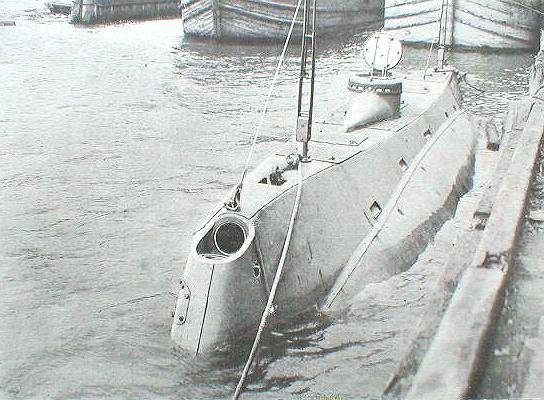
 

Holland VI which would be commissioned as the USS Holland in 1900 The bow tube is open in this photograph which was taken from the deck of the "Scientific American" in 1898

Holland VI which would be commissioned as the USS Holland in 1900
The bow tube is open in this photograph which was taken from the deck of the “Scientific American” in 1898


In addition to the British, The Japanese also adopted Holland’s design for their navy. The Royal Navy submarine HMS Holland 1 is on display at the Submarine Museum, Grosport, England. USS Holland was decommissioned in July 1905. In 1910, Henry A. Hitner & Sons purchased the Holland for scrap. It was sold to Peter J. Gibbons in 1915 and displayed at the Bronx International Exposition of Science, Arts, and Industries in New York. From there the Holland was moved to Patterson, New Jersey where it was displayed until 1932. In 1932, this historic submarine was again sold as scrap and destroyed.
Comments Off on John P Holland, American Submariner Extraordinaire

Filed under New

“WayBack Wednesday” A Look At One Of Your Favorites: March 23, 2016


The H.L. Hunley A Look At History


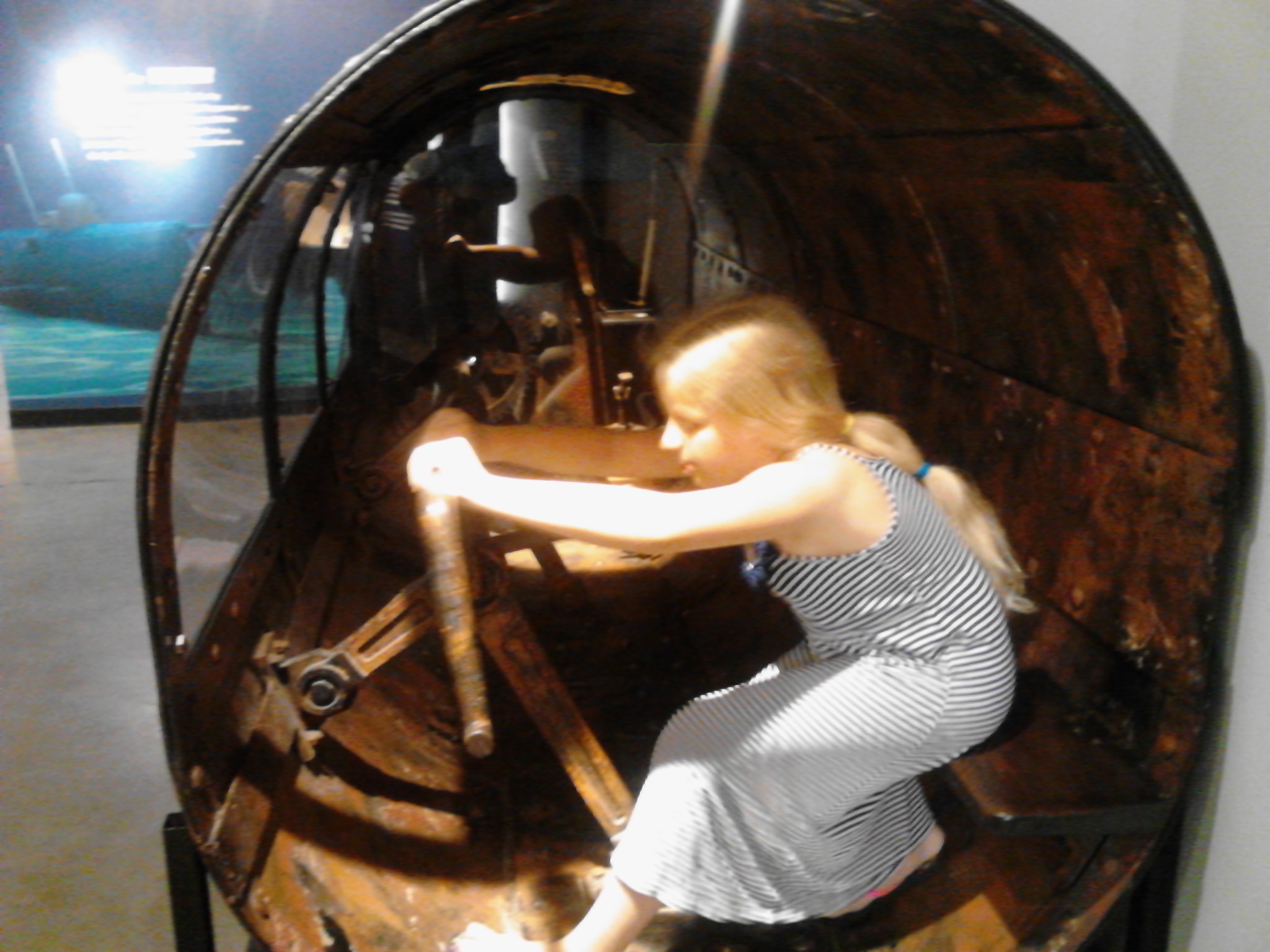
Elizabeth inside a full size replica of the Hunley.

Elizabeth inside a full size replica of the Hunley.

Comments Off on “WayBack Wednesday” A Look At One Of Your Favorites: March 23, 2016

Filed under New

Simon Lake ~ Submarine Pioneer


Simon Lake (before 1923) United States Public Domain

Simon Lake (before 1923)
United States Public Domain

Simon Lake, a naval architect with more than 200 patents to his name. Lake competed with John P. Holland to build the first submarines for the United States Navy. Holland and Lake both built submarines for many navies and they are the father’s of the modern submarine. From childhood he had a strong interest in undersea travel.

Lake, born 4 September 1866 in Pleasantville, New Jersey, built his first submarine the Argonaut Junior in 1894 in response to a United States Navy request for a submarine torpedo boat. Argonaut Junior was a prototype 14 feet long, 4 feet wide, 5 feet in height, it had a lockout chamber in enter and exit the submarine while submerged and it had three wheels on the bottom to keep it from getting stuck on the sea bottom. The two man crew propelled the submarine by hand cranking the two drive wheels.

In 1898 he built the 36 foot Argonaut 1 and sailed it 1,000 miles from Norfolk, Virginia to Sandy Hook, New Jersey. Taking what he learned from the trip he rebuilt the Argonaut 1 renaming it Argonaut 2 and extending its length to 60 feet.

His next submarine was the Protector, but the navy did not except any of the three submarines. Lake sold the Protector to the Imperial Russian Navy in 1904 and it was renamed Osetr. He did not have the financial resources of Holland so he spent the next seven years in Europe building submarines for Russia, Germany, and Austro-Hungary.

Ripe with success in Europe, Lake founded the Lake Torpedo Boat Company in Bridgeport, Connecticut, in 1912. Lake built 26 submarines for the United States Navy during and after World War I. His first submarine for the Navy was USS G-1 SS -19½. USS G-1(named Seal renamed G-1 by the navy) set a depth record of 256 feet in November 1912. The submarine was built on a subcontract at the Newport News Ship Building Company in Newport News, Virginia. The submarine met and exceeded all of the navy’s requirements.

In the 1920s, because of the naval reduction treaties, Lake was forced to close his ship building company. But, he remained an advisor to the United States Navy on maritime salvage and submarine technology until his death on 25 June 1945.


USS G-1, date 1912 United States Public Domain

USS G-1, date 1912
United States Public Domain

Comments Off on Simon Lake ~ Submarine Pioneer

Filed under New

“WayBack Wednesday” A Look At One Of Your Favorites: March 16, 2016


Spence VS Cussler: Who Found The Hunley?


Dr. E. Lee Spence with priceless, ruby studded, over one kilo, 22 kt gold sword handle once owned by 19th century pirate kings of Bali. It was part of a hoard of treasure hidden from the Dutch forces who invaded Java for the purpose of driving out the pirates. (Photo credit: Wikipedia)

Dr. E. Lee Spence with priceless, ruby studded, over one kilo, 22 kt gold sword handle once owned by 19th century pirate kings of Bali. It was part of a hoard of treasure hidden from the Dutch forces who invaded Java for the purpose of driving out the pirates. (Photo credit: Wikipedia)


Clive Cussler (Photo credit: Travelin' Librarian)

Clive Cussler (Photo credit: Travelin’ Librarian)

Comments Off on “WayBack Wednesday” A Look At One Of Your Favorites: March 16, 2016

Filed under New

Villeroi, Verne, The Alligator, and The Nautilus


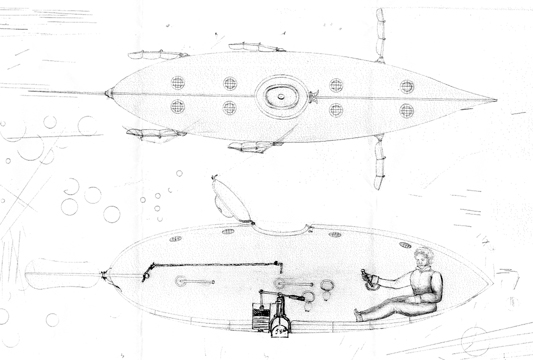
De Villeroi's first submarine. United States Public Domain

De Villeroi’s first submarine.
United States Public Domain

This next submarine designer/builder had a longer career than most, and may have had greater influence than any submariner of the 19th century, though we will never know conclusively. Brutus de Villeroi a Frenchman born in 1794 and died in 1874 born in Tours, but lived most of his life in Nantes. Yes the same Nantes that Jules Verne grew up in. It is quite possible, though impossible to prove, that young Jules Verne may have witnessed the testing of one of Villeroi’s submarines.

Image of the Nautilus from Jules Verne's "Twenty Thousand Leagues Under The Sea" - 1869 Image by illustrator Neuville for the book.

Image of the Nautilus from Jules Verne’s
“Twenty Thousand Leagues Under The Sea” – 1869
Image by illustrator Neuville for the book.

What we do know is that Villeroi was, supposedly, a professor of drawing and mathematics at Saint-Donatien Junior Seminary in 1842, though the records proving it have not been found as of yet. This was at the same time Jules Verne attended the same seminary. Verne also maintained friendships with people from Nantes for the rest of his life. So it is possible that Verne’s Nautilus may have been inspired by Villeroi’s Nautilus, which in turn inspired untold thousands to become submariners.

Villeroi built his first submarine in 1832 and named it Nautilus after Robert Fulton’s Nautilus. Villeroi’s Nautilus was 10 feet 6 inches long, 27 inches high, and 25 inches wide displacing 6 tons when submerged. The submarine had eight dead-eyes along the top to allow in light. It also had a retractable conning tower with a hatch. The ship was propelled by three sets of duck-foot paddles. The ship had a crew of three. The submarine was demonstrated near Nantes, France on 12 August 1832. For the next 31 years Villeroi tried to sell his various submarine designs to the French navy, but was turned down every time.

In 1856, he immigrated to the United States and continued to work on his submarine designs. His first American built submarine was a salvage submarine captured by the Philadelphia police as it sailed up the Delaware River on 16 May 1861. This got the attention of the Philadelphia Navy Yard, which led to a contract to build a much larger submarine for the United States Navy. The submarine was over budget and over time.

The submarine, named the Alligator, was 30 feet long and 6 feet in diameter. It had 16 hand operated paddles for propulsion. Air was supplied through an air pump attached to two hoses connected to two floats on the surface. The submarine was sent to Norfolk, but no one really knew what to do with it. Finally the submarine was sent back to the Philadelphia Navy Yard and the propulsion was replaced with a hand cranked screw propeller. This improved her speed to four knots.

Admiral du Pont ordered the submarine to Charleston to take part in an attempt to take the city. While the submarine was being towed to Port Royal, South Carolina by the USS Sumpter the two ships were caught in a storm and the Alligator was cut loose and sank on 13 June 1862.

Although the Alligator was the United States Navy’s first submarine, it was never a commissioned ship in the United States Navy, so it was never the USS Alligator. It would be almost forty years before the United States Navy had another submarine. The next navy submarine was designed and built by American John P. Holland, an immigrant from Ireland.


De Villeroi's drawing of the Alligator. The first United States Submarine (never commissioned as a navy ship). United States Public Domnain

De Villeroi’s drawing of the Alligator. The first United States Submarine (never commissioned as a navy ship).
United States Public Domnain

2 Comments

Filed under New