
The Missing Crown Jewels of Russia.


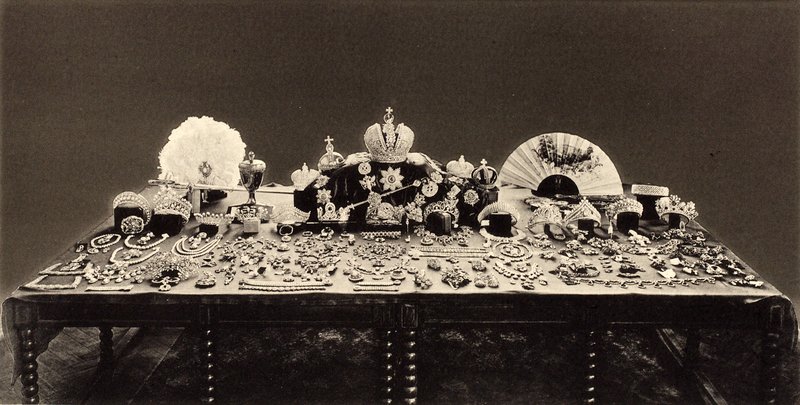
 After the 1917 revolution, Russia's new rulers debated what to do with the crown jewels. This 1925 photo shows the collection. However, a 1922 album at the U.S. Geological Survey includes photos of four items that are not described in the official 1925 inventory. www.usgs.gov


After the 1917 revolution, Russia’s new rulers debated what to do with the crown jewels. This 1925 photo shows the collection. However, a 1922 album at the U.S. Geological Survey includes photos of four items that are not described in the official 1925 inventory.
http://www.usgs.gov

Well after the communist revolution of course the crown jewels of Russia (known as the Diamond Fund) went missing. Right? Well no actually. There was much debate by the communist after they took over. Many saw the Diamond Fund as symbols of exploitation of the people and wanted them sold. But, the curators at the Kremlin in Moscow were able to convince the leaders of the communist revolution that the Diamond Fund had great historical significance saving the jewels. Some minor pieces of the Diamond fund were sold and auction records of the sales have been kept. There was also an official photographic record made of the Diamond Fund which was published in 1925. The book and records of the Kremlin match. So then there are no missing jewels from the Diamond Fund – right? Not so fast.

About a half dozen years ago Richard Huffine, the director of the US Geological Survey Library was in the rare books section when he came across an odd book. This book had no markings on the cover or spine. When they opened it up the title page was an elaborate hand-drawn page. They had the title translated into English “The Diamond Fund.” Now you are saying “so?” This hand-made book was published in 1922, three years before the official book was and it has photographs of four pieces of jewelry (a brooch, necklace, diadem and bracelet) not in the official 1925 edition.

So the USGS Library called in the experts. They found out that the brooch was sold at an auction in London in 1927. No one knows what happened to the other three pieces. The man who originally acquired the book was George Kunz. He was a mineralogist who worked for Tiffany & Co. and in the 1890’s he traveled extensively in Russia.

Another expert brought in was historian Igor Zimin, (head of the history department at the St. Petersburg State Medical University). He is skeptical of the book though because it was dated in 1922 and the first official photographic inventory of the Diamond Fund was taken in 1925. If you would like to see photographs of the missing pieces and learn more about this remarkable 1922 book you can go to the USGS website.
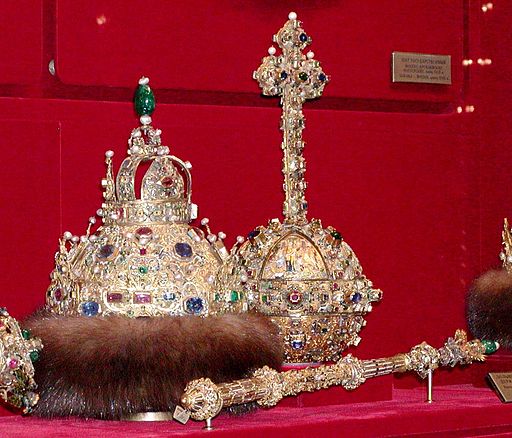
 

Photo of Russian royal regalia on display in the Kremlin Armoury, Moscow, photograph taken August 2003 by Stan Shebs
Photo of Russian royal regalia on display in the Kremlin Armoury, Moscow, photograph taken August 2003 by Stan Shebs

 

Comments Off on The Missing Crown Jewels of Russia.

Filed under New

“WayBack Wednesday” A Look At One Of Your favorites: April 27, 2016


With summer almost on us in the northern hemisphere, how would you like to go on a vacation – have fun and get rich?

Today’s WayBack Wednesday takes you to a treasure that has still not been found. So, get your suitcase packed, grab a map, a thermos, and let’s go look for Nothing Says Elegance Like Fabergé (Lost Treasures Part 2).

16491939584_5416a41768_b

Comments Off on “WayBack Wednesday” A Look At One Of Your favorites: April 27, 2016

Filed under New

The Lost Nazi Treasure of Lake Toplitz


Lake Toplitz is an alpine lake in Western Austria. The lake is a mile long and three hundred feet deep. Sunken logs in the lake make diving very dangerous and many divers have died in the lake’s depths. Visibility is good only to about thirty feet and below sixty feet there is no oxygen in the waters. During 1943-44 the German navy used the lake for testing. Early in 1945, as the Third Reich crumbled Nazi trucks stopped at the Weisenbecker home waking up the occupants. They ordered the people to harness their horses to wagons in order to take a cargo to Lake Toplitz. The horses were harnessed and wooden crates were transferred from trucks to the wagons.  Ida Weisenbecker is still alive and has been interviewed many times about what she saw. On the third and final wagon trip to the lake she saw Nazi officers dumping the creates into the lake.

Since that day treasure hunters have scoured the lake in search of lost Nazi gold. Hundreds of millions of dollars, possibly billions, were missing after the fall of Nazi Germany. Many believe the Nazis hid gold, silver, and jewels throughout Europe and some of that is hidden in Lake Toplitz. To date only counterfeit banknotes and papers have been taken out of the lake. But the treasure hunters continue their search. Even the news program 60 Minutes gotten into the act.

So what is really on the bottom of Lake Toplitz? Most likely more creates of counterfeit banknotes and documents the Nazis wished to keep out of the hands of the allies. Some of those documents may contain the bank account information to Nazi bank accounts in various countries.

What of the Nazi gold? While it is true that the Nazis stole tons of gold and took the gold teeth from concentration camp victims (melted down into bars) that gold was most likely deposited in Swiss bank accounts and transferred into financial vehicles much easier to transport than gold bars. Some of that gold may still be in Swiss banks. For decades the Swiss have sought to hide their role as bankers for the Third Reich. But, documents continue to surface indicating more and more Swiss involvement in the affairs of Nazi Germany.

Swiss gold coins minted in the mid 1940s have mercury levels ten times the level expected in gold coins. Mercury was used in the gold used to create, fillings, crowns, and teeth. It is suspected those Swiss gold coins may have been made from gold fillings, crowns, and teeth of people killed in the Nazi concentration camps. But we will never have solid evidence to tell us what happened to all the Nazi gold and silver.

So, is there Nazi gold at the bottom of Lake Toplitz? Probably not, but maybe ….


60 Minutes Special part 1

60 Minutes Special part 2

Comments Off on The Lost Nazi Treasure of Lake Toplitz

Filed under New

“WayBack Wednesday” A Look At One Of Your favorites: April 20, 2016


With summer almost on us in the northern hemisphere, how would you like to go on a vacation – have fun and get rich?

Today’s WayBack Wednesday takes you to a treasure that has still not been found. So, get your suitcase packed, grab a thermos, pick, and a shovel and let’s go look for Yamashita’s Gold (Lost Treasures Part 1).

gold-coins-201

Comments Off on “WayBack Wednesday” A Look At One Of Your favorites: April 20, 2016

Filed under New

A Sojourn In Words


It is 2:30AM and I cannot sleep ~ again. Sitting in my window looking south. An occasional car passes, but mainly I see the lights of the city. Centered in the window of my “Eagle’s Nest” (so dubbed by my neighbors) are the green lights of one building in particular. It sits on the corner of Main and 2nd streets a few blocks from the post office. The green lights frame the pyramidal roof, crowned by two red lights at the peak.

This is my home, it speaks to me and calls my name. The first time I stood here with the realtor waiting on a friend of mine (I always want a second opinion) it spoke to me then. I have never felt so “at home” before. I will not spend the rest of my life here, I cannot, I am a wanderer and a seeker. Even as I live here now I continue to go forth. Sometimes I travel a few blocks, sometimes a few states, or even to another country. No matter where I wander I am always seeking. Sometimes I am seeking even before I know the question. I have the curiosity of a child (and the impudence of one too).

Children are curious about everything. Why is the sky blue? Why is the grass green? Why is water wet? Some people say children are simple ,I prefer wise. When they speak they are always direct, to the point, and short. “Daddy stay.” “I am hungry.” “I love you.” “I am tired.”

We clutter speech.

“Boy – I had a rough day. The traffic lights were out on the way to work, and I was almost late. Two people called in sick and the boss dumped their work on me. Then on the way home there was an accident on I-135. I’m tired.”

There it is, “I’m tired.” All those words, all that time. Five sentences, forty-seven words – why? A child would have simply said, “I am tired.”

On one of my sojourns I met a linguist. In thirty minutes over coffee I learned more about language than I had learned in thirty years. Linguists can compare two languages and by the common speech patterns know which language is older. The older language is shorter, more direct, and not so cluttered with extra words. Russian and Chinese are two of the oldest languages on earth that are still spoken. English is one of the younger languages. (Maybe children are even wiser than I thought.)

I like language, I like words. In ancient times people believed if you knew the one true name of a god you could control that god. Words have power and each word is unique. Adventurers and pilgrims are both travelers, and yet they convey a different meaning, they produce a different mental image for us.

I know some Spanish and a few words in several other languages. Though my native tongue is English. English isn’t just English words, no we borrow words from many languages. I like English I find it so expressive. Why just for the word traveler there are dozens of synonyms, adventurer and pilgrim being just two. Yet with all the variety of English we have only one word for the most powerful word of all – love.

Love is an intangible like liberty. You cannot detect love with your five senses, only the evidence of love. Love is one of only two intangibles for which people will sacrifice their life and all they hold dear (liberty being the other). One word – that’s it – just one word. We love our pets, our children, our parents, our relatives, our friends. All of those are different kinds of love, but still just one word. Our children we are willing to protect at all costs. We nurture them, teach them, we revel in their very essence. When they come home from school and explain to us the sun is a star, we listen as if they are teaching us something we never knew.

Then there is the love we have for a lover. This is the love where we are at our most vulnerable. Then, if we are truly lucky, we experience a love that marks our very soul. It changes you – from the inside, and you are never the same again. That is a love that never dies. If that person dies or you get a divorce or breakup, they are still a part of you. The love you shared marked your soul, it changed you. And though separated by time and space they will always be a part of you.

People talk about the power and the strength of steel and granite. But it pales in comparison with the strength and power of love. Look into the eyes of your own child. Do you feel that within your breast? See how your child looks at you? There is nothing as powerful as love.

Yet, just one word. From pizza to life altering and soul touching we have just one word. Yet if a god, as powerful as a god is, has only one true name shouldn’t the most powerful force of all have just one word?

2 Comments

Filed under notes