“WayBack Wednesday” A Look At One Of Your favorites: May 18, 2016


With summer almost on us in the northern hemisphere, how would you like to go on a vacation – have fun and get rich?

Today’s WayBack Wednesday takes you to a treasure that has still not been found. So, get your suitcase packed, grab a thermos, pick, and a shovel and let’s go look for The Holy Grail (Lost Treasures Part 5).

"Holygrail" by Dante Gabriel Rossetti - Unknown. Licensed under Public domain via Wikimedia Commons -

“Holygrail” by Dante Gabriel Rossetti – Unknown. Licensed under Public domain via Wikimedia Commons –

Comments Off on “WayBack Wednesday” A Look At One Of Your favorites: May 18, 2016

Filed under New

Are You Ready to be Rich?


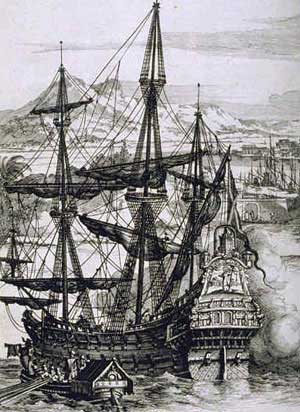
"Spanish Galleon". Licensed under Public domain via Wikimedia Commons -

“Spanish Galleon”. Licensed under Public domain via Wikimedia Commons –

If you read my “WayBack Wednesday” article you read about the Spanish 1715 Treasure Fleet. You also know that there were eleven ships in the 1715 fleet and two of those ships have never been found. Yes, that is right. Hundreds of millions of dollars in gold, silver, and jewels are laying on the bottom somewhere waiting to be found. If you have not had a chance to read the article yet, you may click on that article’s title below and read the article.

Lost Ships of the 1715 Spanish Treasure Fleet (Lost Treasures Part 4)

For more than 300 years now people have been salvaging the treasure from the 1715 Spanish Treasure Fleet. To review shortly. The 1715 Fleet left Cuba sailed up the east coast of Florida where it was hit by a hurricane sinking on the coast of Florida 9 out of the eleven ships. The last two ships have not been found and are assumed by the experts to lie on the east coast of Florida somewhere.

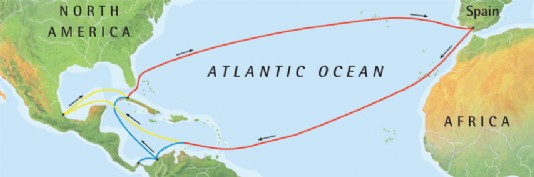
To understand what happened to the 1715 Fleet and where the two missing ships might be we need to understand the route these fleets used to go from Cuba to Spain. The treasure ships of Spain in the New World would gather in the harbor of Havana, Cuba. Once all the ships were assembled and provisioned for the return to Spain they would sail from Havana. The fleet would follow the Gulf Stream along the coast of Florida between Florida and the Bahamas. Somewhere north of Cape Canaveral the fleet would turn eastward sailing towards the Azores in the eastern Atlantic. Once the Azores were sighted the fleet would turn towards Spain on the last leg of the journey.

The 1715 fleet left Havana heading towards the east coast of Florida. Along the coast of south eastern Florida the sea changed with long slow swells coming into the area, a sign to experienced sailors that a hurricane was on its way. The storm hit while the fleet was along the east coast of Florida. It has been assumed that all eleven ships of the fleet were wrecked along the coast of Florida because none of the ships returned to Spain. To date nine of the ships have been found.

But …

What if …

The missing two ships did not sink on the coast of Florida? What if the two ships were damaged and taking on water, but the ship captains believed their ships could still reach Spain. What would the captains have done?

They would have continued north, then after passing Cape Canaveral they would have changed course to the Azores using the route known to the Spaniards as Carrera de Indias (Highway of the Indies). Once sighting the Azores they would have turned southeast towards Spain. The Azores had already been inhabited for since the 15th century. If the ships reached the Azores and the damage was worse than they thought off the coast of Florida they could have sailed into port in the Azores and repaired their ships.
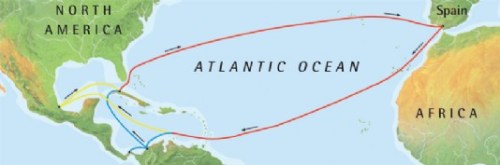
Carrera de Indias (Highway of the Indies) The routes of the Spanish treasure fleets.

Carrera de Indias (Highway of the Indies)
The routes of the Spanish treasure fleets.

But the two ships never pulled into the Azores, and were never sighted off the coast of the Azores. So the ships have not been found on the coast of Florida and do not appear to have reached the Azores. So where are the last two ships of the 1715 fleet?

I believe that the last two ships of the 1715 fleet are not lying on the coast of Florida, but on the bottom of the ocean somewhere between Florida and the Azores. The experts will continue to say the two ships sank on the Florida coast. But in 300 years they have never been found on the coast of Florida and they never reached the Azores or Spain. To me it seems logical the only place left is on the bottom of the ocean between Florida and the Azores. If you were to find these two ships today you would not see the actual ships themselves, the wood has long ago rotted away. You would find the ships with a metal detector detecting hundreds of millions of dollars of gold and silver sitting together just under the sandy bottom of the western Atlantic Ocean.

If you do find the ships and the hundreds of millions on them – how about loaning me $100,000. There is a piece of land I have had my eye on for some time.

Thank you and have a wonderful week.

gold-coins-201


2 Comments

Filed under New

“WayBack Wednesday” A Look At One Of Your favorites: May 11, 2016


With summer almost on us in the northern hemisphere, how would you like to go on a vacation – have fun and get rich?

Today’s WayBack Wednesday takes you to a treasure that has still not been found. So, get your suitcase packed, grab a thermos, pick, and a shovel and let’s go look for the Lost Ships of the 1715 Spanish Treasure Fleet (Lost Treasures Part 4).

"Spanish Galleon". Licensed under Public domain via Wikimedia Commons -

“Spanish Galleon”. Licensed under Public domain via Wikimedia Commons –

Comments Off on “WayBack Wednesday” A Look At One Of Your favorites: May 11, 2016

Filed under New

This Piece of Treasure May Be Your Financial “Declaration of Independence.”


gold-coins-201

Many of the “lost treasure” stories are much like what people believe about the Titanic. On a scale of 1 to 10, with ten being the case with the strongest favorable evidence, they rank somewhere around a 2 or 3. But people convince themselves that they are a 10. If someone with some expertise, training, or experience in the field tries to help them they do not want to hear it. And their excuses for why the other person is wrong are even sillier than their own reason for believing.

But today I am going to tell you about one treasure hunt where the treasure is real. Just like in any treasure hunt where the treasure is real, there are no maps where “X” marks the spot. No cryptic riddles left in the spine of a dusty old book in the storage of a library or archive, and no deathbed confessions about where the treasure is hidden. Originally, there were 200. In 1949, there were only 14 of these gems known to exist. Since then an additional 12 have been found, with the last one found in 2009. But I get ahead of myself.

John was a typical printer in his time. He lived and worked in Philadelphia. He was a twenty-nine year old Irish immigrant. It was a hot summer day, a Thursday to be exact. He would be closing up his shop and heading home soon. Until two men came in with a rush job they needed printed that very day. It was a big order, about 200 copies, but he set to work. His printing press used lead letters that had to be set up individually and inked. Then the paper would be set in the press. It was a screw type press that had to be hand operated to transfer the ink to the paper one sheet at a time. It took a while to set the typeset. Then the two customers stayed to inspect the prints as they came off, which led to a few minor changes. Making the changes slowed him down. But they accepted and paid for the ones before the changes they would use them too, so that was good. At least he was paid for all the prints.

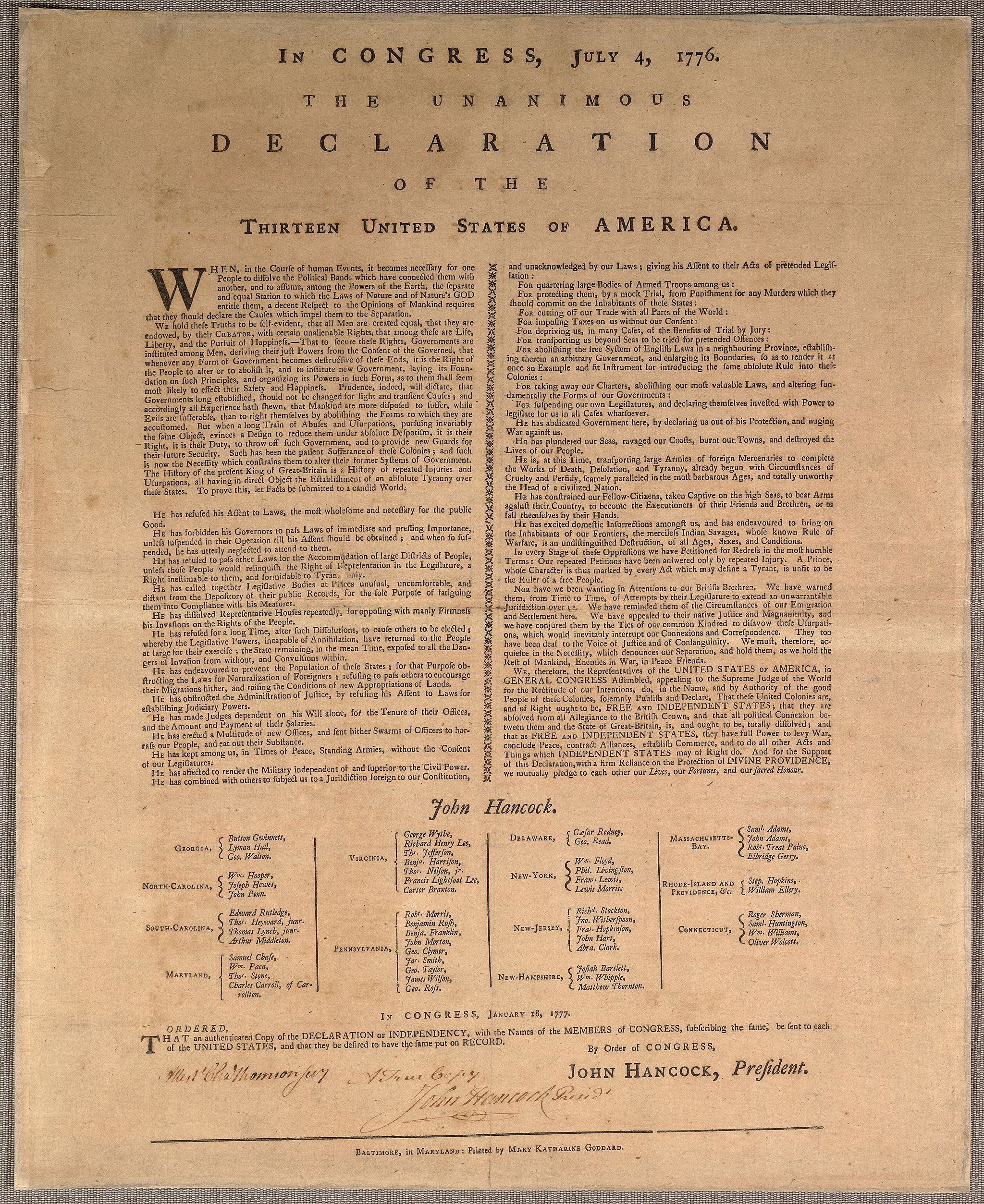
When John was finished with the order, the customers rushed from the printing office with the announcements. These copies were to be sent out immediately all over the country, from Georgia in the south to New Hampshire in the north. It is this flyer, this announcement, this broadside that is the treasure. If you happen to be lucky enough to come across one of these broadsides printed by John Dunlap it would be worth several million dollars. These Dunlap broadsides were the first copies on the Declaration of Independence, printed on Thursday July 4, 1776. One easy way to tell if you have a Dunlap broadside or a Goddard broadside (the second official printing printed six months later, 9 copies known to be in existence) is the Dunlap does not list the names of the signers – they had not signed it yet because it had only just been approved. The Goddard broadside lists the names of all the signers except Thomas McKean, who in January 1777 had not had an opportunity to sign it yet.

Of the 200 hundred copies, 26 are known to exist. Many of course have been destroyed over the years, but there is no doubt that of the remaining 174 copies a few are still in existence just waiting to be found. Of the 12 found since 1949 one was found with some papers of Thomas Jefferson. One was found on the back of a framed picture and purchase at a junk shop for $4. One was found being used to wrap other documents to protect them, and one was found in the National Archives of the United Kingdom. I can’t tell you where to look, but I can tell you more will be found, so keep your eyes open and just maybe you’ll get a chance to quit your day job.


The Dunlap Broadside Printed the night of July 4, 1776.

The Dunlap Broadside
Printed the night of July 4, 1776.


Goddard Broadside printed January 1777.

Goddard Broadside printed January 1777.


There were many different broadsides authorized by the states after the announcement of the declaration more than 15 that are known of. This broadside was authorized and printed in Massachusetts.

There were many different broadsides authorized by the states after the announcement of the declaration more than 15 that are known of. This broadside was authorized and printed in Massachusetts.


Comments Off on This Piece of Treasure May Be Your Financial “Declaration of Independence.”

Filed under New

“WayBack Wednesday” A Look At One Of Your favorites: May 4, 2016


With summer almost on us in the northern hemisphere, how would you like to go on a vacation – have fun and get rich?

Today’s WayBack Wednesday takes you to a treasure that has still not been found. So, get your suitcase packed, grab a map, a thermos, a passport and let’s go look for The Amber Room (Lost Treasures Part 3).

Photograph of the second Amber Room, now on displayed in the Cathrine Palace, St. Petersburg, Russia. Photo credit, Wikipedia.org, public domain.

Photograph of the second Amber Room, now on displayed in the Cathrine Palace, St. Petersburg, Russia.
Photo credit, Wikipedia.org, public domain.

Comments Off on “WayBack Wednesday” A Look At One Of Your favorites: May 4, 2016

Filed under New