Category Archives: Cup-O-Joe

For Those We Love


English: Photo of author Vince Flynn taken by ...

English: Photo of author Vince Flynn taken by Phil Konstantin in San Diego on October 31, 2008. (Photo credit: Wikipedia)

This week saw the loss of several people we all know of, though most of us have never met. The one who caught my eye and occupied many of my thoughts this week was novelists Vince Flynn. Vince was 47 years old. He was diagnosed with cancer three years ago. There were several things I contemplated while thinking of Vince. I have several personal friends and acquaintances who have fought cancer, some of whom lost their valiant struggle. Vince is a couple of years younger than I, and his youngest daughter is one year older than my daughter. Then of course Vince wrote 14 best sellers, and I write (I am still working towards my first best seller). Vince is survived by his wife Lysa, a stepson 16, and his two daughters 11 and 9.

Cover of "Term Limits"

Cover of Term Limits

Like so many bestselling authors, Vince’s first novel, Term Limits, was rejected by the established publishers. He collected 60 rejection slips before he self-published Term Limits, which went on to become a success, after which he received a publishing contract and an agent. He wrote 15 novels and his latest novel is coming out soon.

I never knew Vince, but there are several things I would like to point out about Vince, things we can all learn from him.

First, he did not quit. How many of us can say we could take 60 rejection slips and still push forward. Like so many of the other people I have written about over the past year, Vince did not become successful on his first try, his second, or even his sixtieth. When people kept shutting the door on Vince, he created his own door, publishing his first novel on his own. Perseverance, that is what it takes to be successful.

His family morns him now, but they have their memories which they will always cherish, the best of all legacies. Equally important to Vince, if not his family, is his ability to provide for his family even after he has left them. Copyrights are good for 50 years after the death of the author, they are also transferable like other property (such as money, houses, cars) and can be bequeathed in a will to your survivors. So, until June 19, 2063, Vince’s royalties from his work will continue to be paid to the family he loved so much. His children will be older than I am now when the copyright runs out. His grandchildren, yet to be born, will also benefit from his work as a bestselling author.

It is very fortunate for not only his family, but also us his readers, that Vince persevered and published Term Limits on his own. If he had put his writing aside instead of publishing it himself, it would be sitting on a shelf somewhere today, collecting dust. It is rare for a discarded manuscript to be published after the author’s death. So, what are we to learn from Vince?

Finish your book, no more excuses, finish your book. Fiction, non-fiction, poetry (poke poke Mon Chere), it matters not what you are working on, PUBLISH YOUR WORK.

Louis L'Amour

Louis L’Amour (Photo credit: Wikipedia)

Second, even if you have not published anything before today, tomorrow make sure you include a clause in your will stating who receives your copyrights when you die (for me that person is my daughter). You can leave your copyrights to anyone, even a charity if you wish. Louis L’Amour left his copyrights to his son and daughter; to this day (25 years after his death) new printings of Louis’ work continue to be released under their direction and benefit. You can take care of those you love, for the next 50 years.

Though it is a pretty safe bet your work will be no more popular tomorrow than it is today, you cannot make that claim for ten years from now, next year, or even next month. The single most important influence to your financial success is the taste of the public. Yes, I know (please no comments refuting that last statement) the quality of your work is important, and you should never be satisfied with your work. You should always strive to make your next piece better than your last. However, if you go to Amazon.com you will see many bestsellers replete with editing errors.

There comes a point of diminishing returns, sure you could rewrite again, but your work is as good as it will ever be. Spending another month or another year, you may find a few more places to rewrite a few words. At that point, you are merely finding excuses not to publish. Except for a few people (who have as their main vocation writing bad comments and reviews), readers do not expect perfection, they expect good.

So, get those poems together and publish them (poke poke Mon Chere). Stop rewriting (for another 100 times) that book of fiction or non-fiction, and publish. PUBLISH.

While you are at it, checkout Vince’s last book when it comes out. If you have not read any of his work, download one of his books today or buy a print copy. Vince is one of us, a writer, he is a coworker of ours. When you get your first (or next) Vince Flynn novel you will not only be buying a good read, but you will be helping your coworker take care those he loved, for the next 50 years … and that ain’t too bad.

Thank you Vince. Thank you for showing us, for showing me, an unselfish example of perseverance and strength.

Vince’s website is www.vinceflynn.com

4 Comments

Filed under books, Cup-O-Joe, family, New, notes, writing

Where Success With People Begins and Ends.


Do Unto Others …”

By James R. Fisher, jr.

In my years as a corporate executive and then consultant, I’ve learned this: while technical systems change rapidly, the systems that govern our social behavior have evolved little in 2000 years. And we get we want out of life only by working with and through others.

To maintain that perspective in my life, I wrote down some rules that seem to flow from it. Here they are:

To have a friend, you must be a friend,

starting with yourself.

The greatest hunger a person has is to be needed.

Help create that feeling in others.

The greatest virtue is kindness.

You can’t love everyone, but you can be kind to everyone.

Don’t try to impress others.

Let them have the fun of impressing you.

Be enthusiastic.

Nothing of consequence was ever achieved

without enthusiasm.

Be positive.

Positive people attract others, while negative people repel.

You have greater impact on others

by the way you listen than by the way you talk.

Gossip cheapens the one who gossips

more than the one gossiped about.

Call a person by his or her name

and use it often in conversation.

Communicate cheerfulness.

Differences are bound to occur and can be resolved if

conflict is managed in a polite manner.

If you are given to making fun of someone,

be sure it is yourself.

Be genuinely interested in others.

Get them to talk about themselves.

A smile doesn’t cost anything and pays big dividends.

Not only does it make you feel good, but

it makes everyone else feel better too.

Be the first to say, “Hello! Good to see you.”

“Do unto others as you would have them do unto you.”

The golden rule is where it all begins and ends.

2 Comments

Filed under Cup-O-Joe, family, New, Southern, thoughts

Two Sons of Camelot


This is another of those pieces I wrote long ago. I wrote this after John died. I never thought of myself as a writer so I never kept anything.

John and I both came from Camelot, not the kingdom of so many centuries ago, or from the one thousand days of an American Presidency. But, from a surreal place, a place that was never meant to be surreal. A place that was always meant to be real and tangible, but never was, nor ever will be. This was a Camelot that was intended to expand — encompassing the whole world with its perfection.

John left Camelot suddenly, after a birthday party. My expulsion was slow. I never knew I had left, until one day I looked around me, realizing I was lost in an imperfect world.

I never knew John, but I would have liked to have shared a cup of coffee with him … just once. Maybe on a forgotten dock, where sandpipers played in the surf, their cries carried on an ocean breeze that caresses you ever so gently, both body and soul. We could have sat like long lost friends, and talked about nothing at all. Comforted by the fact that though we had little in common, we were both sons of Camelot.

The Last Defender of Camelot (2002 book)

The Last Defender of Camelot (2002 book) (Photo credit: Wikipedia)

1 Comment

Filed under Cup-O-Joe, history, New, thoughts

The Greatness Within You


Joe Louis (left) poses with Max Schmeling

Joe Louis (left) poses with Max Schmeling (Photo credit: Wikipedia)

First, let me give my disclaimer. In this column, I will use the masculine form of the personal pronoun. This is a literary device, not politics; this column applies to everyone, men, women, and children.

There is an expression, “Behind every great man, you will find a great woman.” A book could be written on the many great truths of that simple sentence. In the United States, we call the generation who fought World War 2 “The Great Generation.” However, greatness does not happen in a vacuum. Among writers, the standing joke is it takes twenty years of hard work to be an overnight success.

In the case of The Great Generation, it was 14 years of hard work from 1929 to 1943. The 1930’s is my favorite time in America. Those 14 years of hard work is “the woman behind the great man.” It was the depths of the depression. President Franklin Roosevelt was in the White House, and together with congress, they were creating programs to put America back to work. But, it was slow going. It was during that time the foundations of greatness were implanted in men. Government, families, and friends can give a hand up, but greatness, true greatness only comes from within.

Greatness cannot be given to a man, or implanted in him. Greatness only comes when a man faces a challenge so great, he feels his failure is guaranteed. It is at that moment when a man stays average or rises to the greatness that is within him. A greatness that is within all of us, but few ever achieve. You look into the abyss of certain defeat, and you accept the challenge. If you succeed, you can go on to greater things. If you fail, you have a choice to make. “Do I pick up and persevere, or do I take my place in the crowd.” Those men we think of as great from world history, failed many times; but they always picked up and persevered. Henry Ford had several failed car companies before he succeeded; Thomas Edison failed 1,000 times before he made the incandescent light bulb.

We think of the 1930’s as the time of the great depression, a time when people were desperate and down on their luck. There were people in Kentucky who were eating weeds to stay alive, and people in the great dust bowl of the plains who wished they had weeds. When we think of the great works of the 1930’s, most people think of the projects the government designed to put men back to work, like the Hoover dam. They miss the very foundations that created the victory in World War 2. Look at the heroes of Americans in the 1930’s and you will see what I mean.

Joe Louis defeated Max Schmeling in a boxing match that Hitler declared would demonstrate the superiority of the Arian race over all other Peoples of the world, so much for racial superiority. What most people do not know is this was not the first time Joe and Max fought; Max had already beaten Joe before, knocking him out in the 12th round. Americans from coast-to-coast celebrated Louis’ victory, particularly those Americans who were chaffing at the bit of a segregation that though separate, was decidedly not equal.

Then there was a little horse that captured America’s respect and admiration. A horse that inspired all who were down on their luck, to “give it another try.” He was literally little, much smaller than the horses he competed against. When ran he was easy to spot, he threw his legs out in what looked like an awkward gait. By the time he was three years old, the peak age for racehorses, he was an experienced loser. He was not alone though, he was surrounded by losers. First, there was the trainer, a displaced cowboy, many saw as old and tired. There was the jockey who was blind in one eye, and too tall to be a jockey. Last, there was the owner, a man mired in the grief of losing a child, a loss that led to the breakup of his first marriage.

When he began racing for his new owner he was laughed at and ridiculed, “The horse is too small, the jockey too big, the trainer too old, and the owner is too dumb to know the difference.” He didn’t just look bad running, standing still he looked like nothing as well. You see, when he started winning, it wasn’t because of great stamina or strong legs, he had none of that.

When our little pony was younger, abuse was heaped upon him. He was beaten repeatedly as trainers attempted to conform him to the accepted mold of a racehorse. When he did not conform, he was used to train other horses. He was forced to lose to the horses he trained to build their self-confidence. Finally, he was sold to others who raced him. But, he did not race at Churchill Downs and Pimlico, he raced in the lowest of all horse races, the claim stakes. Competing in two races a week he did what they taught him to do, he lost. He was then sold one final time. It was for this new owner that he finally began to win.

His best race, in my opinion, was against a monster of a horse. His nemesis, War Admiral, stood 18 hands tall, bigger than all other horses, and he dwarfed our little pony. A millionaire who had previously owned Man of War, the greatest racehorse in the history of horseracing, owned War Admiral. War Admiral had the best trainer, best jockey, and best stables money could buy. War Admiral won the Triple Crown, America’s three premiere horse races, and easily defeated every horse he went up against by a wide margin.

But, Seabiscuit, an enigma to science, triumphed. Why is Seabiscuit an enigma to science? Because, by everything measurable by science, Seabiscuit should never have beaten War Admiral, or any of the other horses he beat. So, how did Seabiscuit become one of history’s greatest horses? How did this horse win against better horses, with better training, better riders, and better support? He had heart, and three losers who had heart; and saw the heart within the breast of that little pony. You can see the greatness within him in his races. He would look those other horses in the eye, and it was almost as if he said, “Not today, you will not beat me today.” The racetrack operators didn’t “level the playing field” by giving him a head start. No, he had to go head-to-head with horses that looked like racehorses, horses that had star trainers, star jockeys, and owners who knew horseracing and had the money to win. If the races had been made fair for Seabiscuit, he would never have become the great horse that was deep inside of him, he would never have beaten War Admiral. Seabiscuit did not just beat War Admiral, he beat War Admiral on War Admiral’s home track using the starting bell War Admiral was used too and was unfamiliar to Seabiscuit. He beat War Admiral by four furlongs an unbelievable feat.

Seabiscuit’s new team did not attempt to conform him to the accepted mold of what a racehorse should be. They did not demand a just and fair field of competition. They saw the greatness in Seabiscuit, and encouraged that great will power and heart deep within the breast of that little pony.

We all have that kind of greatness within us, the harder the battle, the greater the victory. When my youngest brother was three years old, he asked me to teach him chess. He pestered me until I taught him how to play chess. For more than a dozen years, I beat him every time we played. I could see in his face the pain of defeat, many times, I was tempted to let him win a game, but I did not. If I let him win, he would know I let him win. Maybe not immediately after his victory, but eventually he would know, and this would be as bad as not winning. I knew if he persisted one day, he would win. I never removed one of my pieces or gave any other advantage to him, we always played as equals, even though we were not. I was older by 10 years and 11 months, I had played in sanctioned chess tournaments and had a rating from the United States Chess Federation, there was nothing fair about our games.

I always encouraged him, but never leveled the playing field. Then one day, while I was home from the navy, he beat me. I cannot remember what we said to each other, but I will never forget the look in his eyes. There was a calmness in his eyes, a self-confidence I had never seen before. He had risen to the challenge; he had accomplished this victory by never giving up. I stood there understanding for the first time, the joy Pete  Lamoreaux must have felt the first time I beat him. I knew now that no matter where Jason would go in life, he would succeed. Like Joe Louis and Seabiscuit, Jason had found his own greatness within himself.

4 Comments

Filed under Cup-O-Joe, history, New, notes, thoughts

The 7 Secrets of Great Writing


I saw something the other day that a friend wrote on facebook, and I wanted to share it with you my friends, print this and put it by your “writing device.”
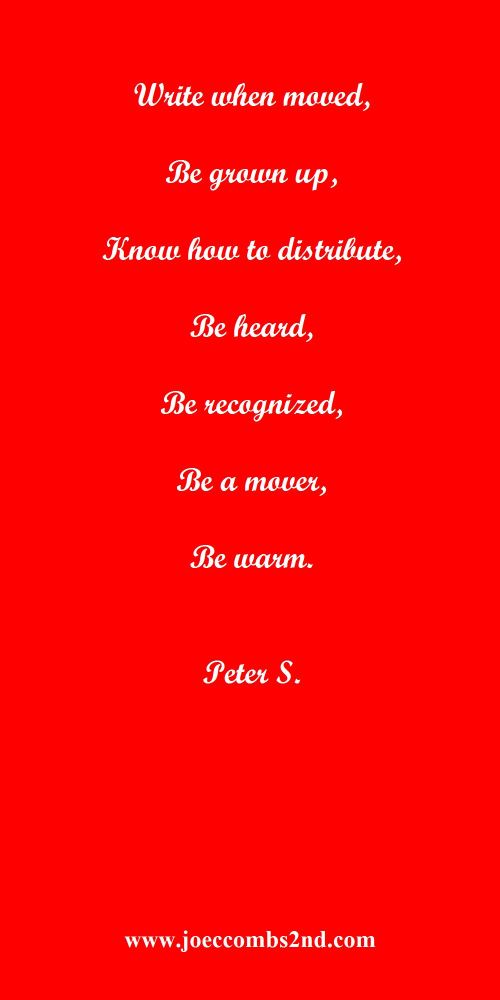
from Peter

I thought about that for a few moments. Then I told Peter I was going to share this. When we think back to our most successful works, regardless of our field or genre we have done this; columns, articles, books, stories, poems. Sometimes we are surprised with the success of something we have written. However, if you take Peter’s concise list in hand, and compare it to your work I think you will find you followed his advice, even if you did not know you were doing so at the time.

Write when moved. We have all had these moments. Sometimes we know exactly what we are going to write. Sometimes we only know the essence of what we are going to write. Sometimes the idea just hits us, all at once, and we begin to write. Other times it is something that nags at our conscious for days, something vague and yet specific. However it starts, when we begin to write it flows, at times it is all we can do to get the words out fast enough. When we are finished, before we begin editing, we look at what we wrote and marvel at how fast it all came together (wishing to ourselves that writing was always like this).

Be grown up. Mmmmm, be grown up. Well, first off, the kind of writing we are talking about is for your public, your regular readers. That is whom I write for. We are not talking about a letter to a lawyer who thinks you are negotiating when you are just trying to do what is right. (A word of advice, do not ever try to do what is right when dealing with a lawyer. If you do, they will not be content, and will continue pushing until they are taking the food from your mouth. Then they will tell you they are letting you off the hook, and you are lucky they are so generous.) Since you are writing for the public, and it would be nice to attract new readers, stay on the positive. There is always a positive and a negative to everything. If you do not see both, keep looking, they are both there. All of us have enough negative in our daily lives. Your readers do not need to turn to you for the negative. They can drive in rush hour traffic and get that. Give them the positive. If you can find the positive where most people miss it, that is even better. Be grown up — stay positive.

Know how to distribute. There is no easy answer for this, you learn over time. Start with a blog, a social network, and some site that will let you publish e-books at no cost to you. Then link them all together. It does not matter what kind of writing you do, you need at least those three. I will give you two examples:

1)      I am a blogger, I am not an author. That may be true. However, no matter how well you map your blog, at some time it will start to become difficult for people to navigate their way around 300 plus posts just to find their favorite posts. When your blog gets to that point, take you most popular posts (the ones with the most views) and put them together in an e-book. You regular readers will appreciate it. Make this e-book free or .99 cents, you are doing this as a gift for your regular readers to show your appreciation of them. Do not put a $14.99 price tag on this e-book, you are not doing this so you can buy a new Porsche, you are creating value for your regular readers. This will expand your regular readers, and show them how much you appreciate them.

2)      I write books, not blogs. That may be true. However, your regular readers have made an investment in you. They have given you their time. Time they could give to loved ones or other interests, but they have chosen to give it to you. So, once a week, or once a month, let them know what you are working on. Take your most popular book and tell your fans how you came up with the idea for their favorite book. Take some of your notes and drafts for a book and let your readers see how that book became the e-book on their e-reader. Let them inside the process. Also, always, always, give them a chance to talk with you. Listen to what they liked and did not like. Answer some of their questions. This will expand your regular readers, and show them how much you appreciate them.

Be heard. There is no magic formula for this, but if you give your readers value, and you appreciate them. You will be heard. How do you do this? Well, you provide value to your readers by teaching them something new, giving them ways to save money, encouraging them, or entertaining them. If you can do several of these at the same time you are doing even better. There is one more though that is a must, no matter what else you do, you must be passionate. I am not talking about romance, love, and sex. I mean you need to be writing about something that is important to you. Poetry, history, blogs, fiction, it does not matter what you write, write what you are passionate about. You cannot fake passion, you can try, and you may pull it off for a while. But, eventually all your readers will see through the ruse. When you write about subjects you are passionate about, you are taking a small part of you and giving it freely (this is not about price), willingly, openly. This is not about 1,000 downloads on Amazon. When someone reads what you wrote, it is an intimate one-on-one conversation — writer and reader. They want your passion; they already have too much in their lives that lacks passion. Why is Norm Abrams so successful? There are many others who can tell you how to build a deck for your house. Norm is successful because he is passionate about home improvement and working with wood.

Be recognized. This is something else that you cannot do very much about, directly. You can enter contests. However, the personal tastes of the judges have more to do with who wins. The type of recognition you should be concerned with is from your readers. When your readers enjoy your work so much they tell others about it, or provide links to your work so others may enjoy it as they do, THAT kind of recognition is exhilarating and humbling at the same time. It is the best kind of recognition you will ever receive.

Be a mover. When you write with passion, believe me, people will be moved to action because of your words. Historical, poetry, how-to, fiction, it does not matter what you write. If you write with passion, you will reach your readers, and they will take that passion and act on it in their own lives.

Be warm. You should never write for “the mob” or the “demographic group” you are shooting for. The United States has more than 350,000,000 people living in it. Just one percent of that is 3,500,000 people. Warmth has to do with passion and intimacy (once again this is not romance, love, and sex). Intimacy is being open and vulnerable it is a one-on-one connection. You do not get that by writing for 3.5 million people. You get that by writing for one person, you get that by holding nothing back, you get that by being positive. You do those three things and the warmth will come through. You do those three things and your readers will become important to you, individuals that you care about, and those feelings will create the warmth. Painting, sculpture, writing these are intimate expressions of you. Be intimate one-on-one with each reader and you will succeed one person at a time.

Now a word about my audience. Writing “how-to” books are always talking about “know your audience, write for your audience.” Those noble educators of the craft of writing are talking about a demographic group. You know, a certain; age, sex, race (sometimes), political view, religious view, and et cetera. This nameless, faceless group is the supposed consumers of your work. Therefore, of course, I do not follow this tact. The group I write for is very specific, and (fortunately for me) gains more faces than it loses.

There is a man who is about my age whom I share much in common, but we have just enough not in common to complement each other.

There is the talented historical author breaking down her own barriers by being both black and female, while possessing a real talent for history.

The poet who bares her soul for the entire world to see, inspiring the most dejected among us while doing so.

There is the couple restoring an historical home, a home that our government should have assumed care for a century ago.

There is the sea captains wife, though she has never said so specifically, I suspect she uses some of their precious, limited time they share to tell him about an occasional column I have written.

There is an extraordinary woman who just lost her soul mate of many years. She has shared the loss that she and her children feel, with her readers. She is dealing with this one day at a time. Some days are not too bad, and the not too bad days are slowly increasing in number. One day she will be back to normal. A new normal, her life will never be the same again. A part of her will always mourn her loss, but she will smile again, and laugh again. Knowing that her husband would want her to, will make it easier for her.

There is a young feminist, an old feminist, and a former feminist, a couple of artists, and some other writers as well. Some are as young as 7 and some as old as 70. I have left out many, but it would take a book length tome to do real justice to them all. They are really a neat bunch of people, whom I treasure. Some leave comments, some send e-mails, and some just read and smile. As I said I do not follow what the experts say we should do to build an audience, I do not have a narrow faceless group of 3.5 million people for whom I write. I write for an individual, someone I care about, someone I celebrate with when they win, someone I cry with when they hurt, someone I care for and pray for, even though they may be an atheist.

The audience I write for is too narrow, I know that. However, it works for me. I did not start writing for just one person. I started writing for this 3.5 million person demographic I wanted to reach. It just did not work for me. If it works for you, use it. But, there will be something else, just one thing all the experts say you should do, one thing you just cannot do.

That one thing robs you of the voice inside you screaming to get out. Follow what the experts say, but when that one thing you are not supposed to do presents its self, follow it. This is what makes you unique; it is your style, your voice.

It will come to you, do not force it, do not say, “I am going to do this and it will be my style.” If you do, it will come across as contrived. Contrived is fake you want genuine. Follow the experts until you reach that point where you say to yourself, “I do not care if I lose all my readers except my mother, I cannot do this anymore.” Then follow your spirit.

You may lose readers, and it may take a long time before you begin to gain readers again. Do it, do it anyway, and do not ever go back to what you did before (remember, if you always do what you always did, you will always get what you always got). What you did before silenced your real voice that is why you left it. Your new audience will come, do not worry about them. They are searching for you right now, waiting on you to find that voice deep within you. They will find you. They will not quit searching for you until they find you. Be patient and as Shakespeare said, “to thine own shelf be true.”

If you have ever studied art seriously, you know that there are certain “rules” of painting. These rules have evolved over centuries; they are really observations of what make paintings attractive to the viewers. Ever see a painting you just do not like? It probably violates several of the observations. Good paintings make you feel at ease, calm, all is right in the world, they follow all the rules. What sets off the good from the great? One observation, one rule … just one. The artist had just one thing he could not bring himself to do (or her). The artist knew to break that one rule could mean disaster for them as an artist, it did not matter. “To thine own self be true.” The truly great did just that. Following all the other observations, they broke one rule and that is what sets them apart from the crowd, that is their style. They said to themselves, “If no one ever buys another of my paintings I do not care. This is what I must do.” You cannot force it, but in time, it will come to you too.

Thank You !!!

Thank You !!!

4 Comments

Filed under books, Cup-O-Joe, New, notes, writing