Author Archives: combs2jc

combs2jc's avatar

About combs2jc

I am a dad first. I am also a writer, artist, submarine vet and adventurous. Most of my writing is non-fiction. I concentrate on memior and history. I also have an annual Christmas book I put out that is free, "Christmas Patrol". "Christmas Patrol" gives vetrans (multiple countries and services) a chance to encourage those men and women currently serving their country during the holidays. My readers have been asking for a website and here it is. Feel free to write, I read everything. Thank You!

You Are Surrounded, and You Don’t Even Know it.


There are many crazy things going on in the world today. People can’t seem to get along, politicians seem to be oblivious, the latest jobs report says that job growth has stalled; everywhere we turn we hear bad news. Not a day goes by that we are not confronted by arrogant, self-centered, self-serving people. Yet, there are people who still give us inspiration. You just need to look with open eyes and an open heart; you never know where you will see them. Believe me when you do see them and you watch as they put others first, try to do a good job, and quietly go about their work (with an integrity many of us thought was gone) it will put a smile back on your face and encourage you to do the same. I want to tell you about three people I witnessed this week.

The first was an elderly lady (cane and all) who was leaving a store. After she went through the door and it closed behind her, she spotted a young woman with an arm load of boxes. She went back to the door, waited on the young woman, and opened the door for her.

A couple of days after that, I pulled into McDonald’s for a cup of coffee. Across the street was a man sitting on the grass by the sidewalk. He wasn’t bothering anyone; he wasn’t asking for change or anything. He was just sitting there with a bag that looked like it held all his worldly possessions, and his dog. The man who walked out of the McDonald’s ahead of me had two bags and two soft drink cups. I watched as he set one bag and one drink on the roof of a car, and headed across the street with the other bag and drink. When he reached the man sitting on the grass he held it out for him. The man stood up to shake his hand, and said something too him. The clean cut Good Samaritan in his business suit waved him off, shook his hand, and walked back across the street. I waited to tell him I thought that was a nice thing he did. He replied, “Oh it was nothing, just fries a burger and something to wash it down with.” Then he was gone. He may have felt like it was nothing, but who knows when the last time was that man and his dog had a meal.

The third guy works at Home Depot in Gahanna, his name is Mike. I heard a husband and wife who were customers of his say, “Mike thought of everything. My husband went to pick out a grill cover for the grill we just bought, but Mike had even thought of that too. Then he stayed after his shift to finish putting it together for us so we could take it home, even though others could have finished it for him.” But, that’s nothing new for Mike, thinking ahead and going that extra step for his customers is what he does every day, for every person who walks in the store. To Mike, it’s just part of his job; and you would never hear him say anything about it. But, we all know too many people who are clock watchers. Too many people do just what the job requires, and little if any more. Too many people willing to attack other people before they even know the whole story. No Mike it’s not “just part of the job,” and though you may not hear it enough, you are appreciated for your efforts.

Each of these people thought nothing of what they did, but it made such a difference to the people they helped. You pass people like this every day, people who put others first and take the extra step. So, stop listening to the news, ignore the negative people. The elderly woman, the suit guy and Mike, if you look you will see them. They will wave you off and say they were just doing their job or they’ll say it was nothing, but don’t let them do that. It is not just part of their job and it is something to the people they help. Tell them you appreciate what they do, and then emulate them. These people set a good example for all of us. Follow that example, pass it on, do something nice just because you see the need; and we can all make this a better neighborhood to live in.

2 Comments

Filed under New

The Lost Ark of the Covenant (Lost Treasures Part 6)


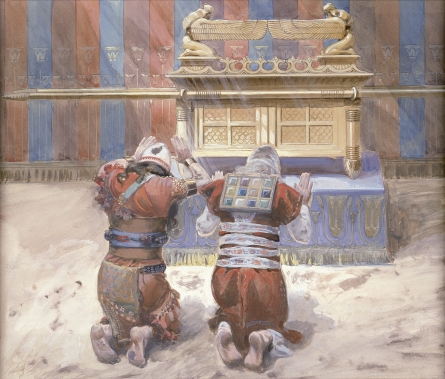
Moses and Joshua bowing before the Ark, painting by James Jacques Joseph Tissot, c. 1900

Moses and Joshua bowing before the Ark, painting by James Jacques Joseph Tissot, c. 1900

A Concise History of the Ark.

The Ark of the Covenant like the Holy Grail has no direct physical evidence to support its existence. However, unlike the Holy Grail, there is much circumstantial evidence to support its existence. This circumstantial evidence does not come from the bible, but comes (mostly) from Egypt.

Tradition says that Moses went up on Mount Sinai where God gave Moses the instructions on how the ark was to be constructed. Israel then carried the ark with them on their trek through the wilderness. The ark was kept in a tabernacle which was a tent used as the House of God. Then King Solomon built the Temple to house the Ark of the Covenant. Sometime after the death of King Solomon, and most likely before the destruction of the Temple by the Babylonians in 597 BC, the ark disappeared. To this day no one knows where it is, but there are many theories.

So, there you have it a concise history of the ark. Now we will look at the circumstantial evidence that exists outside of the Islamic, Christian, and Jewish Holy books.

Moses.

First, Moses, (if he existed as stated in the bible) was an adopted son of the pharaoh of Egypt. As an adopted son he could not inherit the throne of Egypt. He was also the youngest son, so even if he had been a direct descendent of the pharaoh he would have been at the end of a long list of heirs to the throne. (For more on Moses I recommend reading the books of Genesis and Exodus in the Bible). In Egypt, other sons in similar situations to Moses became religious priests, and it is very probable that Moses was trained as a priest. Also, Moses’ father-in-law, Jethro, was a priest as well.

Similarities Between Egyptian & Israeli Religion.

Moses training as an Egyptian priest would account for similarities in religious rituals established by Moses for the new religion, and some religious rituals of Egyptian religion. The Egyptian god Aten translates into Hebrew as Adon and means Lord. The religion of Aten was a monotheistic religion, unlike the other Egyptian religions. The first recorded monotheistic religion of people. There are many more similarities between the two religions, including circumcision. The practice of circumcising males is of Egyptian origin and predates the Jewish tradition of circumcision.

The Ark.

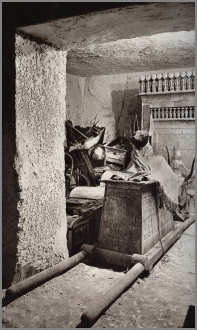
Even more telling is the description of the ark itself. An object common in Egypt at that time, arks can be seen in Egyptian art and have been found in tombs as well. At the opening of King Tutankhamen’s tomb by Howard Carter arks of similar dimensions and design can clearly be seen in the photographs taken at that time. The Egyptians also had portable thrones for the pharaoh of similar dimensions with winged entities on them. To the Israelites the Ark of the Covenant was a throne for God and the holding place of the Ten Commandments (along with other objects important to the Israelis), the lid for the ark was called the Mercy Seat, and God was said to meet the priests between the winged cherubim above the Mercy Seat.

When Moses came down from Mount Sinai with the instructions to build the Ark of the Covenant, he had instructions for an ark that was Egyptian in its size, design, and appearance. He gave those instructions to men, Bezalel and Oholiab, who were familiar with building similar arks for Egyptians when they lived in Egypt.

At the very least it would appear the story of Moses was adopted from Egypt. But, there was no need to just copy the story. The ark was a common and familiar item in Egypt and would have been familiar to the Israelis. The ark would have been easy to build by skilled craftsmen. There would be no reason to make up a story about the ark when it would have been so easy to build. As the Israelis were already used to seeing arks in Egypt, and used to them being associated with the pharaoh and with Egyptian religions, the Israelis would have readily accepted the Ark of the Covenant.

Islam and the Ark.

The Ark is mentioned in the Islamic holy books just as with the Israelis and Christians. But, even more than that there is an indentation on the surface of the Foundation Stone of the World which is the same dimensions as the Ark of the Covenant. The Foundation Stone of the World is the large stone which rests under the Dome of the Rock on the Temple Mount. The Dome of the Rock is the third holiest site in Islam. Though the exact location of the Holy of Holies in Solomon’s Temple is not know, it is commonly believed that the Foundation Stone of the World was in the Holy of Holies, and that the Ark rested upon that stone.

"The rock of the Dome of the Rock Corrected". Licensed under Public domain via Wikimedia Commons -

“The rock of the Dome of the Rock Corrected”. Licensed under Public domain via Wikimedia Commons –

The Israeli Temples.

No archeological evidence exists to support the existence of Solomon’s Temple. It was Solomon’s Temple that was destroyed by the Babylonians in 597 BC. The Temple of Herod was supposedly built on top of the original site of Solomon’s Temple. The Wailing Wall in Jerusalem is the last remnants of the second Temple. The Wailing Wall is what had been the exterior western wall of Herod’s Temple. Herod’s Temple was built after Solomon’s Temple was destroyed and the Ark disappeared. The second Temple was destroyed by the Roman’s during the Jewish Revolt in 70 AD. So, there is physical evidence for the second Temple (the Wailing Wall), but it does not provide evidence of the first Temple (Solomon’s Temple) or of the Ark of the Covenant.

What Happened to the Ark?

According to 2 Maccabees chapter 2 verses 4 – 10, the ark was hidden on Mount Nebo. 2 Maccabees is a book which appears in the Catholic bible, but is not in the Protestant bible.

The Ethiopian Orthodox Church claims the Ark of the Covenant is kept in Axum in the Church of Our Lady Mary of Zion. A view also held by Graham Hancock, which is the topic of his book The Sign and the Seal.

Ron Wyatt claimed to have found the Ark in an underground cave in Jerusalem.

According to the Lemba tribe of South Africa and Zimbabwe, the Ark was taken to Africa by way of Yemen. The Ark, according to their oral tradition, self-destructed and the priests made a replica from the remains. That replica is now in the Museum of Human Science in Harare.

Ah, now the Knights Templar. You knew they would make an appearance. According to French author Louis Charpentier the Knights Templar took the Ark to Chartres Cathedral.

Still others believe the Ark was taken to the village of Rennes-le-Chateau in France, and then to the United States by Freemasons at the beginning of World War One.

Several places in Israel, Rome, England, Ireland and even Egypt have been named as the final resting place for the Ark of the Covenant. There are some who believe the ark discovered in Tutankhamen’s tomb is not just similar to the Ark of the Covenant, but IS the Ark of the Covenant.
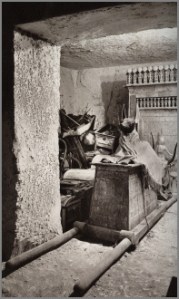
1922 photograph of the tomb of Tutankhamun. Photograph by Harry Burton (1879-1940)

1922 photograph of the tomb of Tutankhamun. Photograph by Harry Burton (1879-1940)

An entire library would be needed to hold all the books that claim to know what happened to the Ark of the Covenant. But, the bottom line is no one has ever been able to produce the Ark of the Covenant.

If found, the Ark of the Covenant would be the greatest archeological discovery of the century and maybe of the millennium, and could possibly start a new wave of Holy Wars involving Muslims, Christians, and Israelis. The best evidence for the existence of the Ark is circumstantial, but even circumstantial evidence fails to provide any support for the existence of the ark today.

Wrap Up.

There are two groups of people who will strongly disagree with this article. The first group is those who believe that the Christian, Jewish, and Muslim religions are myths or fairy tales. Many of these people deny any physical evidence that supports Jewish people in the Middle East before the 20th century. The second group is some of those who are members of these three great religions. They will take offense at my comparisons to the Egyptian Cult of the sun god Aten.

I understand the concerns of these two groups of people. However, this article was not written to debunk religion or to support religion. This article was written to take a look at the Ark of the Covenant as a physical, real, object made from common materials (gold and wood) by men. I have searched for evidence, physical or circumstantial, to support its existence in antiquity and today. I have found no hard physical evidence to support the ark ever existed. I have found considerable circumstantial evidence to support the ark did exist in antiquity. A very small amount of that circumstantial evidence has been presented in this article. And though many of the theories of what happened to the Ark are very interesting, none of them provide verifiable, hard, physical evidence to support the theory that the Ark exists today in the 21st century.

Of the many theories on the disappearance of the Ark, I find Graham Hancock’s theory in The Sign and the Seal, to be the most intriguing.

If the Ark of the Covenant does exist today, I believe it is within walking distance of the Dome of the Rock which is situated on the Temple Mount. No one knows when or how the Ark disappeared, it was just suddenly missing. I believe this supports the idea that the Ark was secretly taken from the Temple in the dead of night. This would explain the mystery. For the priests to be able to take the Ark without anyone being aware the Ark was missing, they would have had to take it at night, and would have had to been back before daylight. If it was known at the time when the Ark was taken, but the authorities had been unable to get the priests to tell where, then the record would be able to give us a date for the disappearance. But, it is a total mystery, which indicates that the only people who knew the Ark had been moved were the priests who moved it.

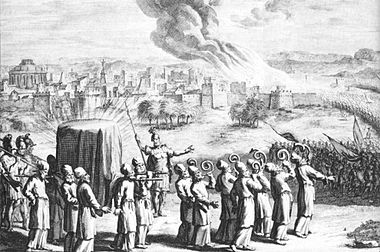
The covered ark with golden staves carried by the priests, and seven priests with rams' horns, at the Battle of Jericho, in an eighteenth-century artist's depiction.

The covered ark with golden staves carried by the priests, and seven priests with rams’ horns, at the Battle of Jericho, in an eighteenth-century artist’s depiction.

This means they would have had to have returned before they would be missed. So, my conclusion is the Ark is within a short walking distance of the Temple Mount. If it does still exist, and is ever found, I hope for the sake of peace, the Ark is found only after Christians, Muslims, and Israelis learn how to peacefully live side-by-side.

 

Comments Off on The Lost Ark of the Covenant (Lost Treasures Part 6)

Filed under New

This Week.


I would like to apologize to you. My migraines have returned and I was unable to complete my article on the Lost Ark. I will however get it to you as soon as possible.


Joe

1 Comment

Filed under New

JUST A QUICK NOTE TO OTHER BLOGGERS


This is a re-run, because it seems someone missed it the first time.

Note to my fellow blogger who attempted to comment yesterday:

I am sure your weight loss program is every thing you say it is. However, it has nothing to do with the Amber Room and for that reason your comment was marked as spam. Please read the below statement.

“If you are one of those bloggers who likes to put non-specific comments on other bloggers sites, so people will click on your name and go to your web site, sorry to disappoint you. If I do put your comment up – I remove your web address first. In other words, I just wasted your time, just like you are wasting my time.

Have a nice day

🙂

Joe”


Sorry to the rest of you for re-running this, but it appears I needed too.

Have a great day,

Joe

3 Comments

Filed under New

The Holy Grail (Lost Treasures Part 5)


"Holygrail" by Dante Gabriel Rossetti - Unknown. Licensed under Public domain via Wikimedia Commons -

“Holygrail” by Dante Gabriel Rossetti – Unknown. Licensed under Public domain via Wikimedia Commons –

Disclaimer: This article is not about the validity of Christianity. This article is about the Holy Grail as an historical object and about a few of the many theories surrounding the Holy Grail.

The Holy Grail is different from the other lost treasures we have discussed in our series, in that there is no physical or circumstantial evidence to even support the existence of such an object. Even the Ark of the Covenant has a strong circumstantial case for its existence. But, let’s go back in time to the first recorded appearance of the Holy Grail, and the many theories of what the Holy Grail is.

If you believe the Holy Grail is the cup that Jesus used at the Last Supper, and if you believe the record of Jesus and the Last Supper in the bible; then the Holy Grail is a cup with its first mention in writing going back to the late first or early second century. The bible’s only mention of the Holy Grail is that of a cup and no attention is paid to that cup. It is the act Jesus was involved in at the Last Supper which is afforded attention in the bible. No description is given of the cup, or any hint at the disposition of the cup after the Last Supper. It was merely a cup used for wine, and would have been the property of the inn where Jesus and the disciples were eating the Passover Feast. As such, after the dinner was over, the innkeeper would have washed it with the other tableware and reused it.

The first written record of the Holy Grail as a special object was in Perceval le Conte du Graal (Perceval, the Story of a Grail) by Chretien Troyes, a twelfth century French romance writer. In this, the first mention of the Holy Grail, Troyes refers to the Holy Grail as “du graal” or “a grail.” Yes that is correct; Troyes does not even describe it as “THE grail.” It is not Holy, or unique, and is also referred to as a golden serving dish by Troyes.

The Grail did not become Holy until sometime in the 15th century. Some four hundred years after Perceval, the Story of a Grail that the grail goes from “du grail” or “a grail” to “san graal” or “Holy Grail,” and it would be several hundred years further before “san graal” (Holy Grail) would become “sang raal” or “Royal blood.”

After Troyes there were others who took his story of the grail and expanded it, but their work was based on the romance of Troyes. There is no hint of a Holy Grail until more than eleven hundred years after the death of Jesus when Troyes first wrote about it.

Now we will examine the most controversial theory of the Holy Grail, the Royal Bloodline theory. This theory states that the Holy Grail is not a cup or dish, but the womb of Mary Magdalene which was carrying the child of Jesus when he died. There are also different goals and theories within this theory as well. Most (if not all) of these theories depend heavily on the pagan belief in the divine feminine. In this theory paganism is also treated as if it were one religion, which is not altogether correct. Pagan was a name coined by early Christians to denote non Judeo-Christian religions (the prophet Muhammad was not yet born, nor the Islamic religion founded by him). Pagan was a “catch-all” phrase. There was no one Pagan religion.

At that time (and before) it was not uncommon for each village to have its own gods and or goddesses that were unique to that location. As the villages formed alliances it was not uncommon for them to merge their religions together. The common practice of Rome was to add the gods and goddesses of conquered territories to their own long list of gods and goddesses. Another thing about these earlier religions, they were not trying to establish a balance between male and female gods. These people assigned male or female to a god based on the characteristics they attributed to a particular god. If those characteristics were believed by their culture to be largely female, then a god with those characteristics was female; and the same with male characteristics.

There are two major camps in royal bloodline theory. Both lines of thought believe that Jesus and Mary Magdalene were married and had a child, but they differ slightly after that. The first believes that Jesus had a child with Mary Magdalene, and that because he was a father he was a man and not divine. This is amusing, because in paganism we have many stories of the gods having sex with human women who then gave birth to sons and daughters. Hercules is just one example of someone from mythology with a god for a father and a human for a mother.

The other major camp within the royal bloodline theory heavily incorporates the divine feminine within its beliefs, and places Mary Magdalene on an equal level with Jesus. These theorists contend that Jesus represents the divine masculine and Mary Magdalene the divine feminine and that this is a balance of the two as it was intended to be as evidenced by pagan beliefs. This is also odd for the following reasons. Those copies of Jewish text which have been discovered that predate Jesus (I am talking about archeological discoveries here) clearly show that the Jewish religion was a monotheistic religion. The Jews believed that there was only one God, and along these lines they were not even permitted to have idols of other gods (graven images). Jesus was a Jew, and as such would have held those same beliefs. Also, in those Christian documents which have been discovered and which have been dated to the late first century and early second century, Jesus states he was not sent to abolish the law, but to fulfill the law. So, clearly a divine feminine aspect of the followers of Jesus clashes with the most basic and fundamental of beliefs held by Jesus and by those who were followers of Jesus.

A common statement of the royal bloodline followers is that the First Council of Nicaea was convened by Emperor Constantine to create the divinity of Jesus and that they banned all books that showed Jesus was a man and not divine. The only books that were banned at the First Council of Nicaea were the books of Bishop Arius. The reason the writings and teachings of Arius were banned was because he believed that Jesus was a lesser God, not equal to God the Father. He believed in the divinity of Jesus, but not the way other bishops believed. There were no writings banned by the First Council that denied the divinity of Jesus, only the degree of his divinity.

One last thing is the Priory of Sion, the organization which was supposedly founded to protect the descendents of Jesus. This organization has been debunked by journalists and scholars alike (non-Christian journalists and scholars included) as one of the greatest hoaxes of the 20th century.

One last point about holy relics (and the Holy Grail if it existed would surely be a holy relic), holy relics during medieval times were big business. If you had an object, any kind of object, which you claimed had a connection to a Saint, one of the disciples of Jesus, or Jesus himself, people would come from near and far to see those objects. Innkeepers and churches alike made a lot of money from pilgrims coming to see holy relics. This, of course led to a lucrative black market industry in the production and sale of fake relics.

The belief in a Creator is based in faith and cannot be proved or disproved. Objects such as the Holy Grail, the Ark of the Covenant, and the Shroud of Turin are physical objects, objects which supposedly have a connection to the divine. Of these three objects the Ark of the Covenant is one object which has any circumstantial evidence for its existence, forget solid physical evidence – it does not exist. That is not to say those three objects are fakes. They very well could be what the faithful claim they are; there is just not enough substantial evidence to back up those claims. If you decide those objects are what others claim they are it is an act of faith. And – after all isn’t that what the belief in a Creator is supposed to be – an act of faith?

So, here we are, in many respects no closer to the Grail than we were five minutes ago. Of the theories we have discussed, the only one which appears to support the existence of the Grail as an actual object that existed is the biblical version. If you believe the biblical version, then the Grail was a cup with no importance placed on it at the time. It probably stayed with the inn and was used many times over after the death of Jesus; only to be discarded with the trash by the innkeeper when it was no longer useful.

There is much more to Holy Grail research. However, it is outside the scope of this article, which is the Holy Grail as a real physical object which did or does exist. As a physical object I think we have shown that if the Grail did exist, it was lost forever the night of the Last Supper when the innkeeper washed and returned the Grail to the cupboard along with the rest of the tableware. In the innkeepers cupboard the Grail would have been indistinguishable from other similar cups.

This article does not take a stance for or against the divinity of Jesus. This is not an article attempting to justify or debunk Christianity as a religion or spiritual belief. Those are decisions for each of you to make individually. I encourage your comments, however if your comments are disrespectful or are attempts to assert your opinion as to the validity of the Christian religion I warn you I will chastise you for diverging from the topic of this article. Here on our web site, we avoid topics concerning finance, partisan politics, and the validity of any religion. We would appreciate you respecting that with your comments.

There are many books worth reading on the subject of the Holy Grail. However, most of them do not deal with the Holy Grail as an actual object with a traceable history. The available books deal with the Holy Grail as a metaphor for something else, or attempt to make a case for an object (with no provenance) as the one true Grail. Many of the cups and dishes purported to be the one true Grail have interesting stories attached to them. Unfortunately none of those “one and true” grails has a history which is traceable beyond 1,000 years ago. For this reason, we are not giving our usual “recommended reading” list.

Next week, the Ark of the Covenant will be our last article in the Lost Treasures series.


Comments Off on The Holy Grail (Lost Treasures Part 5)

Filed under New